Industrial Vacuum Servicing and Maintenance Guide
An industrial vacuum is a working machine that operates in demanding environments, often for hours at a time. Like any machine with motors, filters, seals, and moving parts, it needs regular maintenance to perform safely and efficiently. Unlike a domestic appliance that degrades gradually and is eventually replaced, an industrial vacuum represents a significant investment that should deliver years of reliable service – but only if it is properly maintained.
This guide covers what maintenance an industrial vacuum needs, how often it needs it, what you can do yourself and when you should call a professional, and why servicing is not just about performance but about compliance.
Why Servicing Matters
Performance
The most noticeable effect of poor maintenance is declining performance. Suction drops as filters clog. Seals wear and allow air leaks that reduce airflow. Motor brushes degrade, reducing power. Hoses develop micro-cracks that leak suction. The decline is usually gradual – slow enough that operators adjust their expectations downward without realising the machine is significantly underperforming.
A well-serviced vacuum maintains its rated suction and airflow throughout its working life. A neglected one may be operating at 50–60% of its capability without anyone noticing.
Safety
In M-class, H-class, and ATEX-certified equipment, declining performance is not just an efficiency issue – it is a safety issue. A filter that is no longer performing to its certified level may be allowing hazardous dust to escape. A seal that has degraded may be leaking dust past the filtration system entirely. An ATEX-certified machine with worn components may no longer provide the level of protection its certification implies.
Regular servicing verifies that safety-critical components are performing to specification. Between services, a machine with declining performance could be exposing workers to hazards it is supposed to be controlling.
Compliance
For businesses operating under COSHH, DSEAR, food safety, or pharmaceutical GMP regulations, equipment maintenance is not optional – it is a documented obligation. HSE inspectors, auditors, and regulators can request maintenance records for safety-critical equipment. If you cannot demonstrate that your classified or certified vacuum equipment has been maintained to the manufacturer’s recommendations, you may be deemed non-compliant regardless of the machine’s current condition.
Cost
Reactive repair is always more expensive than preventive maintenance. A filter replaced on schedule costs a fraction of a motor burnt out by running against a clogged filter. A seal replaced during a routine service costs far less than the downtime and emergency repair when the machine fails mid-shift. Total cost of ownership for a well-maintained machine is significantly lower than for one that is run until it breaks.
What a Typical Service Includes
A professional planned preventive maintenance (PPM) visit for an industrial vacuum typically covers motor inspection including brush condition, commutator check, and bearing assessment. Filter inspection, cleaning, and replacement if required. Seal and gasket checks across all connection points, including the tank seal, filter housing, and waste disposal system. Tank and chassis inspection for damage, corrosion, or wear. Hose and accessory assessment for cracks, blockages, or wear. Suction and airflow testing to verify the machine is performing to specification. Electrical safety testing (PAT testing or equivalent), including cable and plug condition.
For M-class, H-class, and ATEX-certified equipment, the service will also verify that safety-critical components (filters, seals, antistatic systems, safe disposal mechanisms) are functioning to the standard required by the machine’s certification.
Recommended Servicing Frequency
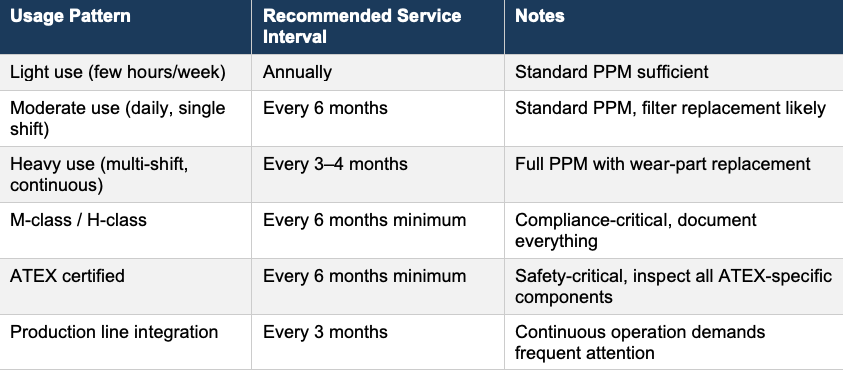
These are guidelines. Your specific servicing schedule should be informed by the manufacturer’s recommendations, the intensity of your usage, and the compliance requirements of your industry. Some facilities with critical applications service quarterly or even monthly.
What You Can Do Between Services
Operators should perform basic checks and maintenance between professional services to keep the machine running well and catch problems early.
Before each use: check the hose and connections for visible damage or blockages. Check the power cable (or battery level) for damage. Verify that the tank is empty and the disposal system is ready. After each use: empty the tank if the machine will not be used again immediately. Remove and inspect the filter for heavy loading. Clean the exterior and check wheels and castors.
Weekly (for daily-use machines): run a brief suction test to check performance has not dropped. Inspect seals around the tank lid and filter housing. Check the float valve (on wet and dry machines) is moving freely. Monthly: replace the filter if suction has dropped noticeably despite cleaning. Inspect hose length for wear, kinks, or cracks. Check all accessories and nozzles for damage.
Common Faults and Troubleshooting
Loss of Suction
The most common complaint. Causes include clogged filter (clean or replace), blockage in hose or nozzle (clear the obstruction), air leak from worn tank seal or loose connection (tighten or replace seal), or worn motor brushes reducing power (professional service required).
Machine Cuts Out During Use
Often caused by the float valve triggering because the tank is full of liquid – empty the tank and resume. Can also indicate motor overheating from a clogged filter or extended operation beyond the machine’s duty cycle rating. If the machine repeatedly cuts out after ruling out these causes, professional diagnosis is needed.
Unusual Noise
New or changed noise patterns usually indicate a mechanical issue. Rattling may suggest a loose component or foreign object in the impeller. Grinding could indicate bearing wear in the motor. Whistling often points to an air leak at a seal or connection. Any new noise warrants investigation before the underlying problem worsens.
Reduced Wet Pickup
If the machine stops picking up liquids effectively, check the float valve first – it may be stuck in the closed position, blocked by debris, or damaged. Also check that the filter has been removed or bypassed for wet operation if the machine requires manual switching.
CFM’s Servicing Capability
CFM North East’s service team are factory-trained Nilfisk engineers. We use genuine Nilfisk parts exclusively, because third-party or pattern parts can compromise performance and invalidate the machine’s certification or warranty.
Our servicing covers Yorkshire, the North East, and the wider northern UK. We offer both reactive repairs when machines develop faults and planned preventive maintenance programmes tailored to your equipment, usage patterns, and compliance requirements.
For businesses with multiple machines or compliance-critical equipment, we can set up a structured PPM programme with scheduled visits, documented service reports, and proactive parts replacement – keeping your fleet running reliably and your compliance records in order.
✔ Free site visit — we’ll assess your facility and recommend the right solution
✔ Call us — 01677 426699 for immediate expert advice
✔ View our range — 75+ Nilfisk industrial vacuums in stock
Request Free Site Visit | View Industrial Vacuum Range | Call 01677 426699