Industrial Vacuum Cleaners: The Complete UK Buying Guide.
The complete UK guide to industrial vacuum cleaners. From dust classifications and power sources to specialist applications and buying advice.
Whatever your application or requirement, whether you manage a manufacturing facility, run a food production line, oversee a pharmaceutical cleanroom, or maintain a busy warehouse, choosing the right industrial vacuum cleaner is one of the most important equipment decisions you will make. The wrong machine costs you time, money, and potentially your compliance status. The right one pays for itself many times over.
Guide Contents
Industrial Vacuum Power Sources: Single Phase, Three Phase, Battery and Pneumatic
Industrial Vacuum Filtration: From Standard Filters to HEPA and Safe Disposal
Specialist Industrial Vacuums: Oil Recovery, Packaging, Hazardous Dust and More
Battery-Powered Industrial Vacuums: Cordless Freedom for Industrial Cleaning
ATEX Industrial Vacuums: Equipment for Explosive Atmospheres
Acquiring Your Industrial Vacuum: Buy, Hire, Lease or Contract Hire
Industrial Vacuum Servicing and Maintenance: Protecting Your Investment
Introduction
At CFM North East, we have spent over 25 years helping businesses across Yorkshire, the North East, and the wider UK find the right industrial vacuum for their specific application. As the UK’s largest stockist of Nilfisk industrial vacuum cleaners, we hold 75+ models in stock, from compact single-phase units starting under £200 through to heavy-duty three-phase systems exceeding £20,000.
This guide draws on that experience. We have written it to help you understand the full landscape of industrial vacuum equipment: the different types available, how power sources affect performance, what dust classifications mean for your compliance obligations, and how to match the right machine to your application. Every section links to a more detailed chapter article if you want to explore a topic further.
No jargon for the sake of it. No product pushing without context. Just practical, expert guidance to help you make a confident, informed decision.
What is an Industrial Vacuum Cleaner?
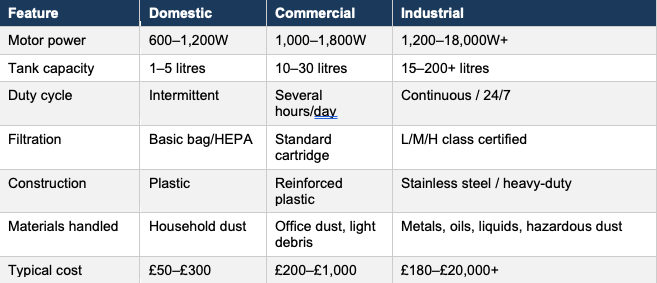
An industrial vacuum cleaner is purpose-built for heavy-duty cleaning tasks in manufacturing, construction, warehousing, and other demanding environments. While the basic principle is the same as any vacuum — a motor creates suction to draw in material — the similarities end there.
Industrial vacuums differ from commercial and domestic machines in almost every meaningful way. Motors typically range from 1,200W to over 18,000W, compared with 600–1,200W in a domestic vacuum.
Tank capacities span 15 litres to well over 200 litres. Construction uses stainless steel, reinforced polyethylene, and impact-resistant components designed for continuous operation in harsh environments. Filtration systems are certified to specific dust classes (L, M, or H) under COSHH regulations, and many models are rated for hazardous or combustible materials.
The most fundamental difference is duty cycle. A domestic vacuum runs for an hour and rests. A commercial vacuum handles a few hours per day in an office or retail setting. An industrial vacuum is engineered to run continuously across a full shift — or even 24/7 in production line applications — without loss of suction or premature wear.
Types of Industrial Vacuum Cleaner
Industrial vacuums are not a single product category. They span a wide range of designs, each engineered for specific materials, environments, and applications. Understanding the types available is the first step toward choosing the right machine.
Wet and Dry Vacuums
The most versatile category. Wet and dry industrial vacuums handle both liquid spills and dry debris with a single machine, making them the go-to choice for workshops, manufacturing floors, and construction sites. Available in both single-phase and three-phase configurations, with tank capacities from 15 litres to over 100 litres. CFM stocks the Nilfisk S3, S3B, T40W, and VHS120 ranges alongside the Viper LSU series for lighter-duty applications.
Oil and Swarf Recovery Vacuums
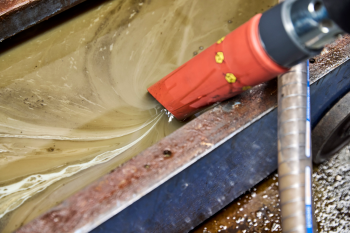
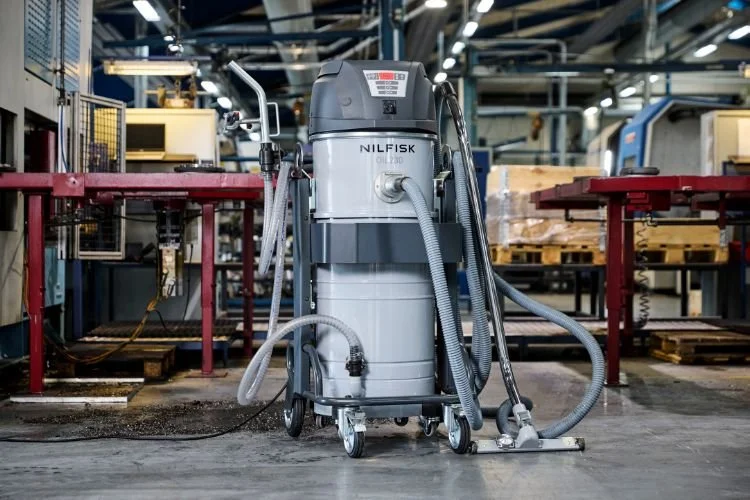
Oil and swarf recovery vacuums are specialist machines for the engineering and metalworking industry. These vacuums collect cutting oils, coolants, and metal shavings (swarf) from CNC machines and lathes, then separate liquids from solids so the coolant can be recycled. This saves significant money on cutting fluid replacement while keeping the workshop clean and safe. CFM stocks the Nilfisk OIL230, ECO-OIL310, ECO-OIL320, and VHO200.
Hazardous Dust Vacuums
M-class and H-class certified vacuums are hazardous dust vacuums for collecting toxic, carcinogenic, or otherwise hazardous materials. These include silica dust from construction, hardwood dust from joinery, asbestos during remediation, and pharmaceutical active ingredients. They feature certified filtration, safe disposal systems, and sealed waste containment. CFM stocks the VHS010 and VHS011 Mini IVAC ranges with Longopac continuous bagging and HC safe disposal options.
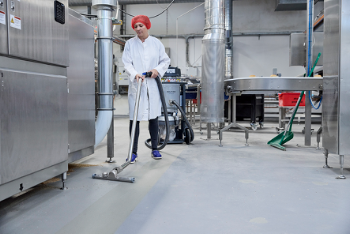
Food Manufacturing Vacuums
Built from stainless steel with smooth internal surfaces food manufacturing vacuums are made or hygiene compliance. Designed for food processing environments where contamination control, allergen management, and BRC or SALSA audit readiness are priorities. The Nilfisk VHW range — including the VHW200, VHW210, VHW310, VHW320, VHW421, and VHW440 — is purpose-built for this sector.
Pharmaceutical Vacuums
Pharmaceutical Vacuums are containment-focused machines for GMP-regulated environments. These feature validated filtration systems, sealed disposal for active pharmaceutical ingredients, and compatibility with cleanroom protocols. Occupational Exposure Band (OEB) considerations drive the specification of these machines.
Packaging and Trim Extraction Vacuums
Designed for continuous extraction of cardboard, plastic film, shrink wrap, and trim waste from production and packaging lines, packaging and trim extraction vacuums are built for sustained, high-volume operation without interruption. CFM stocks the Nilfisk R305 and R104 ranges for these applications.
ATEX Certified Vacuums
ATEX vacuums or environments where combustible dust or flammable vapours create an explosive atmosphere risk. These are certified to ATEX directives and required by DSEAR 2002 regulations. CFM is an approved Nilfisk ATEX supplier with the widest UK stock of certified equipment. For full details, see our dedicated ATEX Industrial Vacuum Superguide.
Compressed Air (Pneumatic) Vacuums
Powered by your facility’s compressed air supply rather than electricity, compressed air vacuums are essential in environments where electric motors are prohibited, impractical, or unsafe. CFM stocks the Nilfisk VHC110 and VHC120 pneumatic ranges, including ATEX-certified variants.
Battery-Powered Vacuums
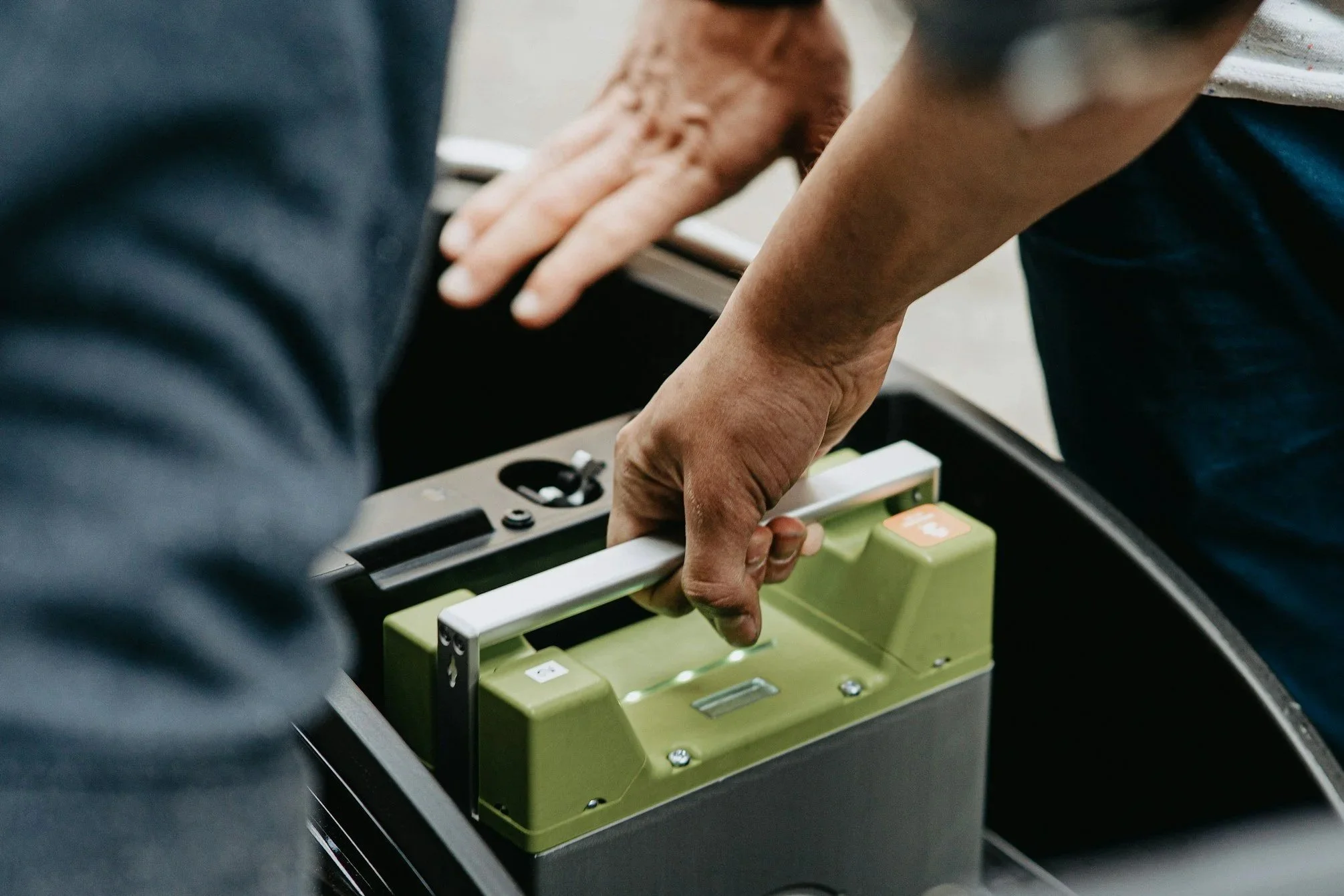
Cordless industrial vacuums offer unrestricted mobility for large facilities without trailing cables or power supply limitations. Nilfisk’s lithium-ion VHB120 and VHB436 models deliver genuine industrial performance without a mains connection.
Mini Industrial Vacuums (IVACs)
Compact, point-of-use units for workstation cleaning, machine maintenance, and small-area applications. The Nilfisk VHS010 and VHS011 Mini IVAC range includes standard, ACD (Appliance for Combustible Dust), and ATEX-certified variants — packing serious capability into a highly portable package
Industrial Vacuum Power Sources: Single Phase, Three Phase, Battery and Pneumatic
The power source of an industrial vacuum determines its suction strength, duty cycle, portability, and suitability for specific environments. Most buyers don’t realise how much this single choice shapes everything else about the machine’s performance.
Single-phase 110V machines are the standard on UK construction sites, where transformer-supplied reduced voltage is a safety requirement. For factory and warehouse environments with standard mains, 240V single-phase units offer more power without needing specialist supply. When continuous, heavy-duty extraction is required — production lines, large-scale manufacturing, three-shift operations — three-phase 415V is the clear choice.
Battery-powered machines are the fastest-growing category. Nilfisk’s lithium-ion technology in the VHB120 and VHB436 delivers genuine industrial performance without cables, making them ideal for operations where trailing leads create trip hazards or where the work area spans multiple zones without nearby power points.
Compressed air vacuums use the Venturi principle, with no electrical components whatsoever. This makes them the only option in certain explosive atmosphere zones and in environments where water or other liquids make electrical equipment unsafe.
Understanding Dust Classifications: L, M and H Class
If your business generates dust, you have legal obligations under the Control of Substances Hazardous to Health (COSHH) Regulations. These obligations include using vacuum equipment with the correct dust classification for the materials you are handling.
Industrial vacuums are classified into three categories based on their filtration capability and the level of hazard they are designed to control:
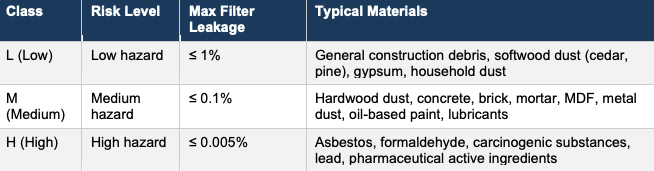
The HSE’s EH40 document sets Workplace Exposure Limits (WELs) for over 500 substances. For respirable crystalline silica (RCS) — generated when cutting concrete, stone, or brick — the limit is just 0.1 mg/m³ over an 8-hour period. Wood dust limits sit at 3–5 mg/m³ depending on the species. These limits drive the requirement for M-class or H-class equipment in most industrial settings.
A critical point that many buyers misunderstand: fitting a HEPA filter to a standard vacuum does not make it M-class or H-class. Classification applies to the entire system — the motor, the seals, the containment, the filter, the disposal mechanism — all tested and certified together. The classification sticker on a certified machine confirms it has passed independent third-party testing as a complete unit.
If you are unsure which classification you need, a simple rule applies: if the dust could harm someone’s health, you almost certainly need at least M-class. If it’s carcinogenic or toxic, H-class. And if it’s combustible, you may need ATEX-certified equipment — which is a separate certification on top of the dust class.
Dust Classification Guide — L, M and H Class Explained →
ATEX Superguide — for combustible dust and explosive atmospheres →
Industrial Vacuum Filtration: From Standard Filters to HEPA and Safe Disposal
Filtration is the heart of any industrial vacuum. It determines what the machine can safely collect, how effectively it protects operators and the environment, and how consistently it performs over time.
Filter Types
Standard cartridge and pleated filters handle general-purpose dust collection. Star filters offer increased surface area for longer service life. M-class antistatic filters are certified for medium-hazard environments. HEPA H13 filters capture 99.95% of particles, while H14 filters reach 99.995% — essential for pharmaceutical and high-hazard applications. ULPA filters go further still, providing the containment levels required for cleanroom environments.
Automatic Filter Cleaning
Over time, filters become clogged with dust, which reduces suction power. Automatic filter cleaning systems pulse a burst of reverse airflow through the filter at regular intervals — typically every 15 seconds — dislodging accumulated dust and maintaining consistent performance. On machines without automatic cleaning, operators must stop and manually clean or replace filters, which costs time and exposes workers to the collected dust.
For any application involving sustained or heavy dust collection, automatic filter cleaning is not a luxury — it is essential for both productivity and safety.
ACD: Appliance for Combustible Dust
ACD stands for Appliance for Combustible Dust — a Nilfisk product designation indicating that the vacuum is designed and certified for the safe collection of combustible dust materials. ACD-designated machines incorporate specific safety features including antistatic construction, conductive components, and sealed waste containment systems that prevent the ignition risks associated with combustible dust handling.
ACD models are commonly recommended in industries where combustible dust is present but a full ATEX zone classification may not apply — for example, general manufacturing environments handling wood dust, certain construction applications, or facilities where combustible dust is generated intermittently rather than continuously. They bridge the gap between standard industrial vacuums and fully ATEX-certified equipment, providing an appropriate level of protection for many real-world combustible dust scenarios.
CFM stocks ACD models across the Nilfisk range, including the VHS010 HC ACD and VHS120 LC ACD. Whether ACD certification is appropriate for your application — or whether full ATEX certification is required — depends on your DSEAR risk assessment and the specific combustible dust hazards present. Our team can advise on the right level of certification for your environment.
Safe Disposal Systems
How dust leaves the machine matters as much as how it enters. Standard bag disposal works for general-purpose collection. For hazardous materials, Nilfisk’s Longopac continuous bagging system seals waste in individual sausage-like bags without exposing the operator to the contents. HC (High Containment) and LC (Low Containment) configurations offer different levels of protection depending on the hazard level. These disposal systems are particularly important on the VHS010 and VHS011 Mini IVAC range, where hazardous dust collection in compact units demands rigorous containment.
How to Choose the Right Industrial Vacuum Cleaner
With so many types, power sources, and configurations available, selecting the right industrial vacuum can feel overwhelming. This step-by-step framework simplifies the decision.
Step 1: What Are You Collecting?
Start with the material. Dry dust and debris, wet liquids and spills, oils and cutting fluids, hazardous dust, combustible materials, packaging waste — each demands a different type of machine. A wet and dry vacuum handles most general applications, but specialist materials like cutting oils, pharmaceutical actives, or combustible dust require purpose-built equipment.
Step 2: How Much Material?
Volume determines both tank capacity and duty cycle. A workshop generating a bin bag of dust per day has different needs from a production line creating continuous waste. High-volume applications typically need three-phase power and larger tanks to avoid constant emptying.
Step 3: What Is Your Environment?
Indoor or outdoor? Temperature extremes? Confined spaces? Explosive atmosphere? The environment shapes both the machine specification and, in some cases, dictates it entirely. An explosive atmosphere requires ATEX certification. A wet environment may rule out electric machines in favour of pneumatic.
Step 4: What Power Supply Is Available?
Check what’s available before you fall in love with a machine. Three-phase vacuums need a 415V supply. Construction sites typically require 110V equipment. If no electrical supply is available or permitted, you need compressed air or battery power.
Step 5: Compliance Requirements
COSHH regulations, DSEAR requirements, food hygiene standards, pharmaceutical GMP — your regulatory obligations will narrow the field significantly. Never compromise on compliance to save on budget.
Step 6: Budget and Acquisition Method
Industrial vacuums range from under £200 for a Viper LSU commercial wet and dry unit to over £20,000 for a Nilfisk 3707 three-phase system. But purchase price is not the only option. Hire, leasing, and contract hire all offer different financial and operational advantages.
If you are unsure about any of these steps, that is exactly what our free site visit is for. Our team will assess your facility, understand your application, and recommend the right equipment without obligation.
Industrial Vacuum Buying Guide - The Complete Decision Framework →
Industrial Vacuums by Industry Sector
Every industry has specific cleaning challenges, compliance requirements, and operational constraints. Understanding how industrial vacuums are used across different sectors helps you identify the right approach for your own environment.
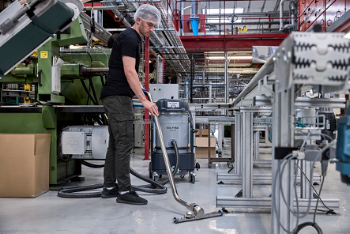
Manufacturing and Engineering
Metal swarf, cutting oils, coolant recovery, production line cleanup, and general factory housekeeping. Manufacturing environments typically need durable three-phase machines for continuous operation, with specialist oil and swarf recovery units for CNC and machining centres. M-class filtration is standard for metalworking dust.
Food and Beverage Production
Hygiene compliance drives everything. Stainless steel construction prevents contamination and makes cleaning the machine itself straightforward. Allergen control, ingredient recovery, and preparation for BRC or SALSA audits all influence machine selection. The Nilfisk VHW stainless steel range is designed specifically for this sector. Where combustible dust is present — flour, sugar, starch — ATEX certification may also be required.
Industrial Vacuums for Food Manufacturing →
Pharmaceutical Production
The most demanding sector for vacuum specification. GMP compliance, containment of active pharmaceutical ingredients, validated filtration, cleanroom compatibility, and Occupational Exposure Band (OEB) requirements all play a role. Safe disposal is critical — operators must never be exposed to collected material during bag changes.
Warehousing and Logistics
Large open spaces with packaging waste, shrink wrap, general dust, and debris. Battery-powered vacuums excel here — no cables to trip over across large floor areas, and no need to hunt for power points. The Nilfisk VHB120 and VHB436 models offer the mobility and runtime these environments demand.
Industrial Vacuums for Packaging and Trim extraction →
Construction
M-class extraction is the HSE baseline for most construction dust, including silica from concrete cutting and hardwood dust from joinery. 110V operation is standard on UK sites for safety. Portability, ruggedness, and ease of filter maintenance are key selection criteria. ACD (Appliance for Combustible Dust) models can also be recommended for construction environments depending upon individual circumstances and the materials being handled.
Woodworking
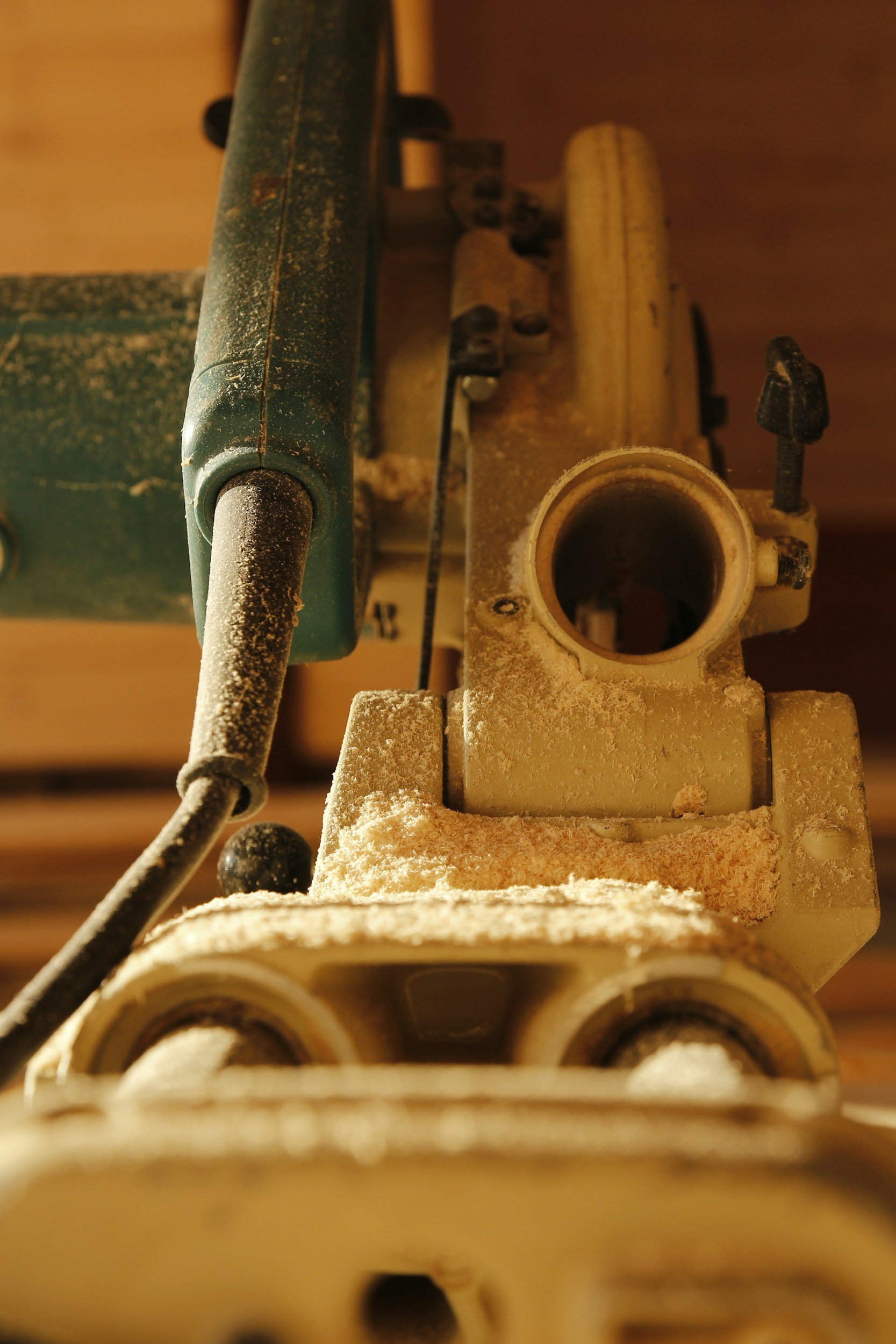
Fine wood dust creates both health and fire hazards. M-class filtration is the minimum for hardwood and MDF dust under COSHH. Where combustible dust concentrations could reach explosive levels, ATEX certification is required. Our ATEX Superguide covers this in detail.
Automotive and Workshops
Brake dust, oil, metal particles, and general workshop debris. Wet and dry versatility is typically essential, with oil recovery capability for vehicle maintenance and engineering workshops.
Specialist Industrial Vacuums: Oil Recovery, Packaging, Hazardous Dust and More
Beyond the general-purpose categories, a range of specialist industrial vacuums exist for applications that standard machines simply cannot handle. These are the machines that set CFM apart from general e-commerce suppliers — because they require genuine application knowledge to specify correctly.
Oil and Swarf Recovery
Nilfisk’s OIL series is purpose-built for the engineering industry. These machines vacuum cutting oils and coolant emulsion together with metal shavings and swarf, then separate liquids from solids through macrofiltration. The recovered coolant is returned for reuse — saving significant money on cutting fluid replacement. The OIL230 handles standard applications, while the ECO-OIL310 and ECO-OIL320 offer higher capacity with oil separation and recycling capability. The VHO200 provides a compact alternative for smaller workshops.
Industrial Vacuums for Oil and Swarf Recovery →
Packaging and Trim Extraction
Production and packaging lines generate continuous waste: cardboard trim, plastic film, shrink wrap, and offcuts. Standard vacuums are not designed for this sustained, high-volume extraction. The Nilfisk R305 and R104 ranges are engineered specifically for integration with production lines, offering the continuous duty cycle and high-volume collection capability these applications demand.
Industrial Vacuums for Packaging and Trim Extraction →
Hazardous Dust (Non-ATEX)
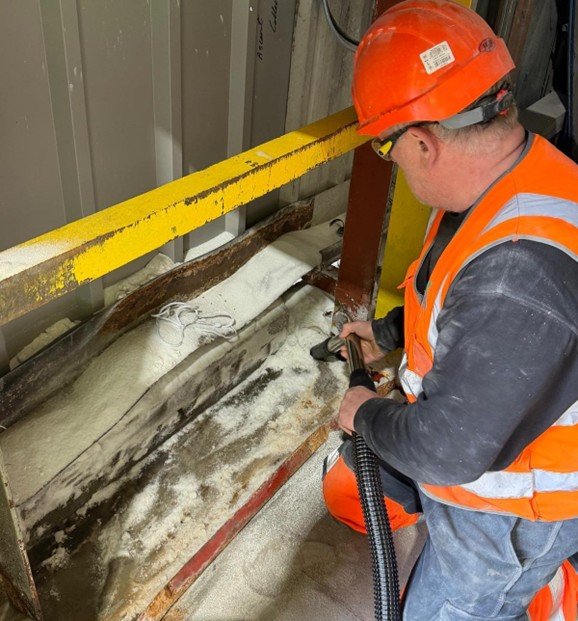
Not all hazardous dust is combustible. Asbestos remediation, silica dust control, lead paint removal, and pharmaceutical active ingredient containment all require certified M-class or H-class vacuum equipment — but not ATEX certification. The VHS010 and VHS011 Mini IVAC range with ACD (Appliance for Combustible Dust) certification and HC (High Containment) safe bag systems are specifically designed for these applications, combining compact portability with serious containment capability.
Single Phase vs Three Phase Industrial Vacuums
This is one of the most common decisions buyers face, and it comes down to three factors: how hard the machine needs to work, how often it needs to work, and what power supply you have available.
Single-phase vacuums — running on standard 110V or 240V supply — are the practical choice for workshops, smaller facilities, intermittent cleaning tasks, and construction sites. They are more portable, less expensive, and plug into standard outlets. CFM’s single-phase range includes the Nilfisk S3 and S3B (starting from around £2,200), the VHS120 series, the ATTIX range, and the Viper LSU series from just £180 for commercial-grade wet and dry cleaning.
Three-phase 415V vacuums are engineered for continuous, heavy-duty operation. Higher-powered motors deliver significantly greater suction and airflow, larger tanks reduce emptying frequency, and robust construction withstands 24/7 production environments. The Nilfisk T40W, VHW320, VHW421, VHW440, VHB436, and the flagship 3707 and 3907 series are all three-phase machines designed for demanding industrial applications. Prices reflect the capability: typically £4,000 to over £20,000 depending on specification.
A 415V supply is standard in most UK factories and production facilities, but not all areas within a site may have three-phase power available. If you are considering a three-phase vacuum, check your supply before committing.
Battery-Powered Industrial Vacuums: Cordless Freedom for Industrial Cleaning
The battery-powered segment of the industrial vacuum market is growing rapidly, driven by improvements in lithium-ion technology and the practical advantages of cable-free operation.
Nilfisk’s VHB120 offers a compact, manoeuvrable cordless unit suited to maintenance cleaning, spot cleaning, and smaller facilities. The VHB436 is the heavy-duty option: a three-phase-equivalent machine with high-capacity lithium-ion batteries, delivering the suction performance and tank capacity needed for production environments — without a power cable.
Battery vacuums make the most sense in large, open facilities like warehouses and distribution centres, food production floors where cables create hygiene and trip hazards, and multi-area operations where moving between zones quickly matters more than sustained extraction in one location.
Where continuous, all-day extraction is needed — production line integration, high-volume dust collection, or three-shift operations — mains-powered machines still have the edge on uninterrupted runtime. But for many applications, the operational flexibility of cordless is transforming how facilities approach industrial cleaning.
ATEX Industrial Vacuums: Equipment for Explosive Atmospheres
If your facility handles combustible dust — flour, sugar, wood dust, metal powder, pharmaceutical ingredients, or any of dozens of other materials — or flammable gases and vapours, you may be legally required to use ATEX-certified vacuum equipment under the UK’s DSEAR 2002 regulations.
ATEX certification is a separate and additional requirement to the L/M/H dust classification covered above. A vacuum can be H-class for hazardous dust filtration but not ATEX-certified for explosive atmosphere use. The two certifications address different risks: dust class protects operator health, ATEX prevents ignition and explosion.
CFM North East is an approved Nilfisk ATEX supplier and holds the widest UK stock of certified ATEX industrial vacuums, covering Zone 22, Zone 21, and Zone 1 applications across single-phase, three-phase, and compressed air power sources.
We have written a separate, comprehensive ATEX Industrial Vacuum Superguide covering DSEAR regulations, zone classifications, combustible dust types, ATEX markings, sector-specific guidance, and equipment selection in full detail. If ATEX is relevant to your operation, that guide is the place to start.
Our Range: 75+ Nilfisk Industrial Vacuums in Stock
CFM North East is the UK’s largest stockist of Nilfisk industrial vacuum cleaners. We hold over 75 models in stock across 12 product categories, meaning the right machine for your application is almost certainly available for immediate delivery.
Our range spans the full Nilfisk industrial portfolio:
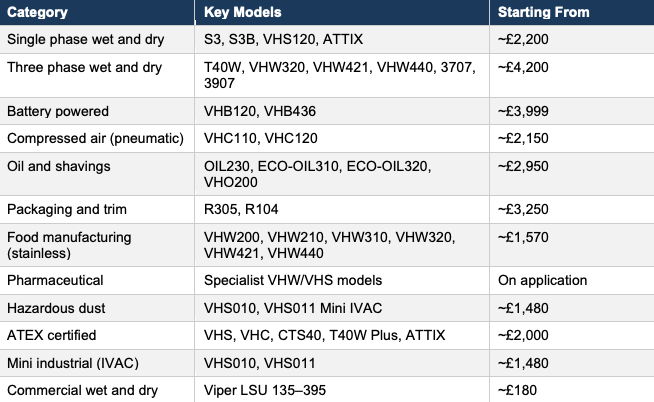
We also carry the Viper by Nilfisk range for lighter-duty commercial applications. The Viper LSU series starts from just £180, offering professional-grade wet and dry capability at an accessible price point for businesses that do not need full industrial specification.
Every Nilfisk machine benefits from Nilfisk’s Danish engineering heritage, global R&D investment, and one of the most comprehensive parts and service networks in the industry. As an approved Nilfisk supplier with over 25 years of partnership, CFM has direct access to technical support, genuine parts, and product expertise that independent resellers cannot match.
Acquiring Your Industrial Vacuum: Buy, Hire, Lease or Contract Hire
Not every business wants or needs to buy outright. CFM offers four acquisition routes, each with distinct advantages depending on your operational and financial circumstances.
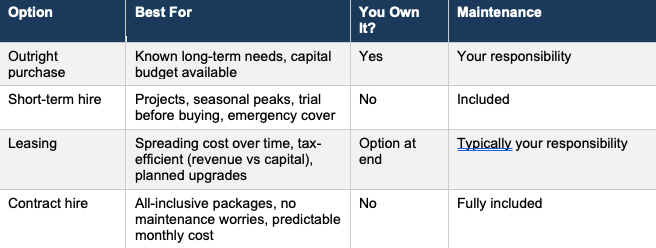
Hire is particularly valuable when you need equipment for a specific project, want to trial a machine before committing to purchase, need cover while your own equipment is being serviced, or face a seasonal peak that does not justify buying another machine.
Leasing offers tax advantages for many businesses because lease payments are typically treated as an operating expense rather than capital expenditure. This can improve cash flow while ensuring you always have current-specification equipment.
Contract hire combines the machine, all servicing and maintenance, and parts replacement into a single monthly payment. It is the simplest, most predictable option for businesses that want to focus on their operation rather than managing equipment maintenance schedules.
Industrial Vacuum Servicing and Maintenance: Protecting Your Investment
An industrial vacuum is a working machine, not a fit-and-forget appliance. Like any equipment with motors, filters, seals, and moving parts, it needs regular maintenance to perform safely and efficiently.
Performance degradation in an industrial vacuum is often gradual — suction drops slowly as filters clog, seals wear, and motor brushes degrade. By the time you notice a significant drop in performance, the machine has been working harder than it should for weeks or months, increasing energy costs and reducing cleaning effectiveness.
A typical planned preventive maintenance visit includes motor inspection and brush replacement if needed, filter inspection and replacement, seal checks across all connection points, tank and chassis inspection, hose and accessory assessment, suction and airflow testing, and electrical safety checks.
For machines used in compliance-critical applications — M-class, H-class, or ATEX-certified equipment — regular servicing is not optional. A poorly maintained machine can fall below its certified performance level, which means it may no longer meet your COSHH or DSEAR obligations, even though the certification sticker is still on it.
CFM’s service team are factory-trained Nilfisk engineers using genuine Nilfisk parts. We cover Yorkshire, the North East, and the wider northern UK, offering both reactive repairs and planned maintenance schedules.
Industrial Vacuum FAQs
What is the difference between an industrial and a commercial vacuum cleaner?
Industrial vacuums are built for heavy-duty, continuous use in demanding environments like factories and warehouses. They feature higher-powered motors (up to 18,000W+), larger tanks (up to 200+ litres), certified filtration (L/M/H class), and robust stainless steel or reinforced construction. Commercial vacuums are lighter, less powerful machines designed for offices, retail, and hospitality settings.
Do I need an M-class or H-class vacuum?
M-class is the HSE baseline for most construction and manufacturing dust, including hardwood, concrete, silica, and MDF. H-class is required for higher-hazard materials including asbestos, carcinogenic substances, and certain pharmaceutical actives. Your COSHH risk assessment should specify the class required for your materials.
What size industrial vacuum do I need?
Size depends on the volume of material being collected and how often you can stop to empty the tank. Small workshops may manage with a 15–30 litre unit. Production environments typically need 50–100+ litres. Consider duty cycle too: intermittent cleaning allows a smaller machine; continuous extraction needs higher capacity.
Can industrial vacuums pick up liquids?
Wet and dry industrial vacuums are specifically designed to handle both liquids and dry materials. They feature liquid-level sensors to protect the motor when the tank fills with liquid. Dedicated oil recovery vacuums (like the Nilfisk OIL series) go further, separating liquids from solids for coolant recycling.
How often should an industrial vacuum be serviced?
As a general guideline, machines in daily use should be serviced every 6–12 months. In high-demand or compliance-critical environments (M-class, H-class, ATEX), more frequent servicing is recommended. Between services, operators should check filters, seals, and suction performance regularly.
What is the advantage of three phase over single phase?
Three-phase 415V vacuums deliver significantly higher suction power, greater airflow, and are designed for continuous operation. They handle heavier materials and higher volumes than single-phase machines. The trade-off is that they require a three-phase power supply and are typically less portable.
Are battery-powered industrial vacuums as powerful as mains?
Modern lithium-ion battery vacuums like the Nilfisk VHB436 deliver performance comparable to mains-powered machines. The main consideration is runtime: battery machines operate for a finite period before recharging, while mains-powered machines run indefinitely. For most cleaning and maintenance tasks, battery runtime is more than sufficient.
Do I need ATEX-certified equipment?
If your workplace handles combustible dust or flammable gases and vapours, a DSEAR risk assessment will determine whether ATEX-certified vacuum equipment is required. Common triggers include flour, sugar, wood dust, metal powder, pharmaceutical ingredients, and grain. Our ATEX Superguide covers this in full detail.
Can I hire an industrial vacuum for a short project?
Yes. CFM offers short-term hire across our industrial vacuum range. This is ideal for project work, seasonal peaks, emergency cleanup, or trialling a machine before committing to purchase. Contact us for hire availability and rates.
What is the difference between HEPA filtration and M-class certification?
HEPA is a filter specification (H13 captures 99.95% of particles, H14 captures 99.995%). M-class is a whole-machine certification covering the filter, motor, seals, containment, and disposal system. You can have a HEPA filter in a machine that is not M-class certified. It is the system certification that matters for compliance.
How do I know which Nilfisk model is right for my needs?
Start with the decision framework in this guide: what are you collecting, how much, in what environment, with what power supply, and what compliance requirements apply? If you are still unsure, our free site visit puts a Nilfisk specialist in your facility to assess your needs and recommend the right equipment, with no obligation.
Supporting Guides in This Series
Each guide explores a topic from this guide in full detail:
Industrial Vacuum vs Commercial Vacuum: What’s the Difference?
Single Phase vs Three Phase Industrial Vacuums: Which Do You Need?
Compressed Air Industrial Vacuums: When Pneumatic Is the Answer
Industrial Vacuum Filtration: HEPA, Cartridge and Safe Disposal Systems
Industrial Vacuum Buying Guide: Selecting the Right Equipment
Not Sure Which Industrial Vacuum You Need? We’ll Help.
Choosing the right industrial vacuum is easier when you have expert guidance. CFM North East has been helping businesses find the right cleaning equipment for over 25 years. We are not a faceless online retailer — we are specialist advisors who understand the applications, the regulations, and the equipment inside out.
✔ Free site visit — we’ll assess your facility and recommend the right solution
✔ Call us — 01677 426699 for immediate expert advice
✔ Request a quote — no obligation, fast turnaround
✔ View our range — 75+ Nilfisk industrial vacuums in stock
Our latest Industrial Vacuum articles