Dust Classification Guide: Understanding L, M and H Class Industrial Vacuums
If you use an industrial vacuum in a UK workplace, the dust classification of that machine is not optional information – it is a legal requirement. The Control of Substances Hazardous to Health (COSHH) Regulations require employers to control worker exposure to harmful dust, and using correctly classified vacuum equipment is a fundamental part of meeting that obligation.
Despite this, dust classification remains one of the most misunderstood areas of industrial cleaning equipment. Many buyers assume that higher wattage or a HEPA filter label means adequate protection. It does not. Classification applies to the complete machine, not individual components.
This guide explains what L, M, and H class mean, which materials require which class, and how to make sure your equipment meets both the legal requirements and the practical needs of your operation.
What Do L, M and H Class Mean?
Industrial vacuum cleaners are classified according to the European standard EN 60335-2-69, which defines three levels of dust hazard and the corresponding filtration performance required:
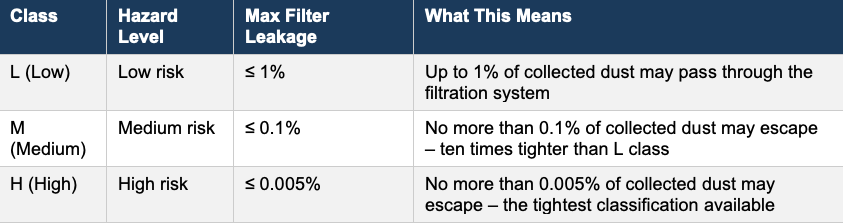
These figures represent the maximum permissible penetration rate for the entire machine – not just the filter element. The classification testing evaluates how much dust escapes from the vacuum as a whole, including through seals, joints, the motor housing, and the waste disposal system.
Which Class Do You Need? Material Guide
The classification you need is determined by the materials you are collecting. The HSE’s EH40 document lists Workplace Exposure Limits (WELs) for over 500 substances, and your COSHH risk assessment should specify the controls required for each material present in your workplace
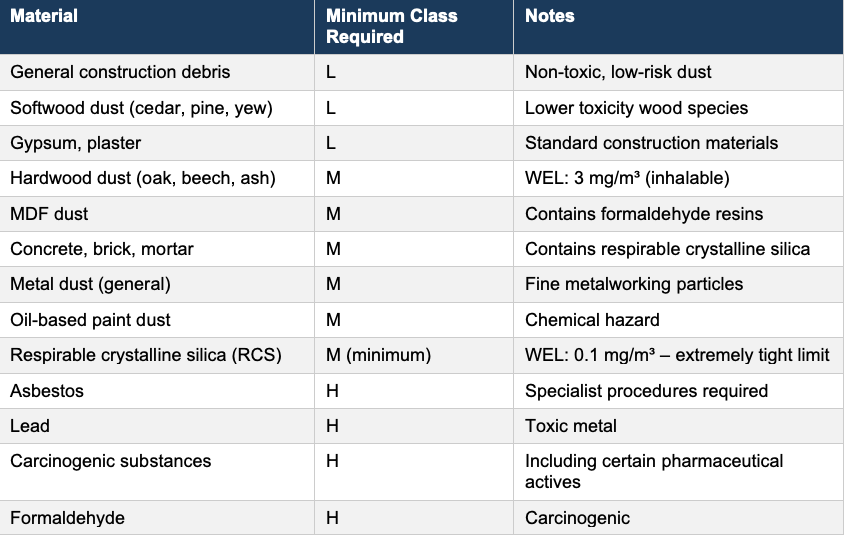
A critical principle: you can always use a higher classification than the minimum required. An H-class vacuum can be used for M-class or L-class materials. But you cannot use a lower classification than required – using an L-class vacuum for hardwood dust is a COSHH breach.
COSHH: Your Legal Obligations
The COSHH Regulations 2002 require every UK employer to assess the risks from hazardous substances in the workplace and implement appropriate controls. For dust hazards, this means identifying the substances present and their Workplace Exposure Limits, implementing controls to keep exposure below those limits, using appropriately classified extraction and vacuum equipment, maintaining equipment to ensure it continues to meet its certified performance, and keeping records of assessments, controls, and maintenance.
The HSE enforces COSHH through workplace inspections. Non-compliance can result in improvement notices requiring corrective action within a set timeframe, prohibition notices stopping work immediately until the hazard is addressed, unlimited fines for organisations, and personal prosecution of directors and managers in serious cases.
For respirable crystalline silica – generated whenever concrete, stone, brick, or mortar is cut, ground, or drilled – the WEL is just 0.1 mg/m³ over an 8-hour period. This is an extremely demanding limit, and meeting it requires M-class extraction as a minimum, combined with other control measures such as water suppression and RPE.
Why a HEPA Filter Does Not Make a Vacuum M-Class
This is one of the most common and most dangerous misconceptions in industrial dust extraction.
HEPA is a filter specification. A HEPA H13 filter captures 99.95% of particles at 0.3 microns. A HEPA H14 filter captures 99.995%. These are impressive filtration rates for the filter element itself.
But M-class and H-class are whole-machine certifications. The classification test measures total system leakage – including dust that escapes through the motor housing, around seal joints, during filter changes, and during waste disposal. A machine with a HEPA filter but poor seals, an unsealed motor compartment, or a standard open-top waste container can leak far more dust than its filter rating suggests.
To be certified M-class or H-class, the entire vacuum must be tested as a complete unit by an independent third-party laboratory. The machine must display a classification sticker confirming it has passed this testing. If there is no sticker, the machine is not classified – regardless of what filter is fitted.
In addition, M-class and H-class vacuums must include specific features beyond the filter: an airflow indicator that warns when suction drops below safe levels, a safe disposal system that prevents dust release during emptying, and in the case of H-class machines, dust-free filter replacement.
How to Identify Certified Equipment
Certified L, M, and H class industrial vacuums must display a classification sticker prominently on the machine. This sticker confirms the machine has been tested to EN 60335-2-69 by an accredited laboratory.
If a machine does not have this sticker, it is not classified. Some manufacturers describe their products as “suitable for M-class applications” or “M-class filtration” without the machine holding actual certification. These descriptions are meaningless from a compliance perspective. Only independently tested and certified machines meet the legal standard.
When purchasing, always ask for the test certificate and check for the classification sticker. Reputable suppliers like CFM North East only stock machines that hold genuine third-party certification.
Combustible Dust: When You Need More Than L/M/H
L, M, and H classifications address the health hazard from inhaling dust. But some dusts also create an explosion risk when they become airborne in sufficient concentration. Flour, sugar, wood dust, metal powder, pharmaceutical ingredients, and many other materials can form explosive atmospheres.
For these materials, ATEX certification is required in addition to the appropriate dust classification. A vacuum can be H-class certified for health protection but still not suitable for use in an explosive atmosphere unless it also holds ATEX certification.
CFM’s ATEX Industrial Vacuum Superguide covers DSEAR regulations, zone classifications, combustible dust types, and ATEX equipment selection in comprehensive detail.
ATEX Industrial Vacuum Superguide →
Choosing the Right Class: Practical Guidance
Start with your COSHH risk assessment. This should identify every hazardous substance present in your workplace and the controls required. If you do not have a current COSHH assessment, that is the first step – before you buy any equipment.
For most manufacturing and construction environments, M-class is the practical baseline. It covers the vast majority of industrial dusts encountered in these settings. L-class is only appropriate for genuinely low-risk materials where no hazardous substances are present.
H-class is required for the most dangerous materials – asbestos, carcinogens, and certain pharmaceutical actives. These applications also typically require specialist safe disposal systems and, often, additional controls beyond the vacuum itself.
If you are unsure which class you need, CFM’s team can help you match your materials and risk assessment to the right specification. A free site visit puts an expert in your facility to assess your requirements without obligation.
✔ Free site visit — we’ll assess your facility and recommend the right solution
✔ Call us — 01677 426699 for immediate expert advice
✔ View our range — 75+ Nilfisk industrial vacuums in stock
Request Free Site Visit | View Industrial Vacuum Range | Call 01677 426699