
Pedestrian vs Ride-On Scrubber Dryers: Which Do You Need?
Choose a pedestrian scrubber dryer for smaller or more congested areas, and a ride-on for large open floors where an operator would otherwise spend a whole shift walking. It is the first decision most buyers face, and getting it correct has a greater effect on productivity than any other single choice.
What is a pedestrian scrubber dryer?
A pedestrian scrubber dryer, also called a walk-behind, is operated by walking behind the machine and guiding it by handle. The format covers everything from very compact machines for small areas up to large traction-driven models with wide decks.
Pedestrian machines suit small to medium floors and spaces where manoeuvrability matters more than raw speed. They turn tightly, reach into areas a larger machine cannot, and store in a modest space. CFM stocks a wide pedestrian range, from the compact Nilfisk SC100 and SC250 through the popular Nilfisk SC351 and SC530, alongside the Viper AS4325B, AS5160 and AS5160T, along with the Truvox Multiwash Pro series.
What is a ride-on scrubber dryer?
A ride-on scrubber dryer carries the operator, who sits and drives the machine rather than walking behind it. This transforms productivity on large floors, because the operator is no longer the limiting factor and cleaning speed rises considerably.
The range spans the Viper AS710R and AS1050R and the Nilfisk BR652, up to the large Nilfisk SC5000 and SC6000 for the biggest facilities. Ride-on machines carry larger tanks, which means longer periods between refilling and emptying, and wider decks that cover more ground per pass.
What about the middle ground?
Many facilities fall between the two formats, with floors too large to clean comfortably on foot but too congested for a full-size ride-on. The Viper AS530R micro ride-on was designed for exactly this situation, offering ride-on productivity in a footprint close to that of a pedestrian machine.
Traction drive is the other middle option. On larger pedestrian machines such as the Nilfisk SC530 BD GO and the Viper AS5160T, the machine propels itself forward, so the operator steers rather than pushes. This removes much of the physical effort without moving to a full ride-on.
How do you decide between them?
Floor area and cleaning time
The larger the area and the longer the daily cleaning window, the stronger the case for a ride-on. Where cleaning runs to several hours a shift, the time a ride-on saves quickly compounds. Small and medium areas rarely justify the additional cost and storage a ride-on demands.
How open or congested is the space?
Open floors favour ride-on machines. Tight, cluttered or shelved spaces favour pedestrian or articulated machines that can manoeuvre around obstacles and reach edges. A large machine that cannot reach half the floor is a poor investment however fast it moves.
Access and storage
Doorway widths, lift dimensions, ramps and the available storage space all constrain the choice. It is worth measuring the tightest point on the cleaning route before settling on a machine width.
Who will operate it?
Ride-on machines require a little more familiarity and, in some facilities, additional operator authorisation. Pedestrian machines are generally simpler for a broad group of staff to pick up.
How do the two formats compare?
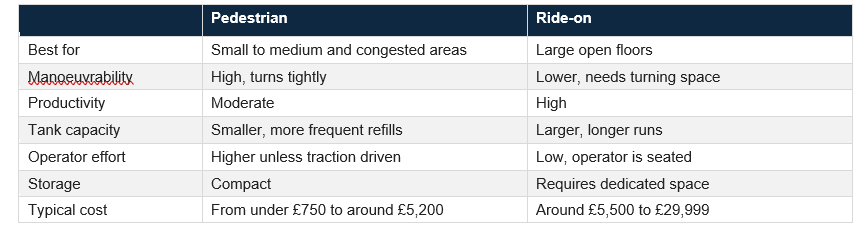
Which format suits your facility?
Cafes, small retail units and washrooms: compact pedestrian.
Schools, care homes and medium retail: mid-size pedestrian, often traction driven.
Supermarkets and mixed retail with wide aisles: micro ride-on or large pedestrian.
Warehouses, distribution centres and manufacturing floors: mid-size to large ride-on.
Can you have both?
Larger facilities frequently do. A ride-on covers the main open floor efficiently while a compact pedestrian machine handles offices, welfare areas, entrances and the spaces the larger machine cannot reach. Where a facility contains production, logistics and office areas, different machines are often required for each, and it is worth assessing the whole facility rather than specifying for the largest area alone.
Not sure which format suits your facility?
We will bring machines to your facility so you can try both formats on your own flooring, with no obligation. Our demonstrations cover the distinct benefits and the pitfalls of each option so you can decide with confidence.
Call CFM on 01677 426699 or request a no obligation demonstration online.