Single Phase vs Three Phase Industrial Vacuums: Which Do You Need?
The choice between single-phase and three-phase power is one of the first decisions when selecting an industrial vacuum – and it shapes almost everything that follows. It determines the machine’s suction capability, how long it can operate continuously, and ultimately what applications it can handle.
Yet many buyers make this decision based solely on what power supply they have available, without fully understanding the performance implications. This guide explains the practical differences so you can choose the right power source for your application, not just your socket.
Understanding the Power Sources
Single Phase 110V
110V single-phase is the standard on UK construction sites, where reduced voltage via a site transformer is a safety requirement. These machines are portable, lightweight, and plug into the yellow 110V outlets found across building sites. They are the entry point for industrial vacuum capability, ideal for intermittent dust extraction during cutting, drilling, and grinding operations.
CFM stocks 110V models across virtually the whole of the Nilfisk range including the S3, S3B, VHS120 and ATTIX ranges. Typical prices start from around £2,200.
Single Phase 240V
Standard UK mains voltage. 240V single-phase vacuums offer more power than 110V equivalents and are the most common choice for workshops, smaller manufacturing units, and facilities where three-phase supply is not available. They plug into a standard 13A socket or, for higher-powered models, a 16A industrial socket.
Virtually all of the Nilfisk range are available in 240V configurations, including the S3, S3B, VHS range, alongside the Viper LSU commercial-grade series for lighter-duty applications.
Three Phase 415V
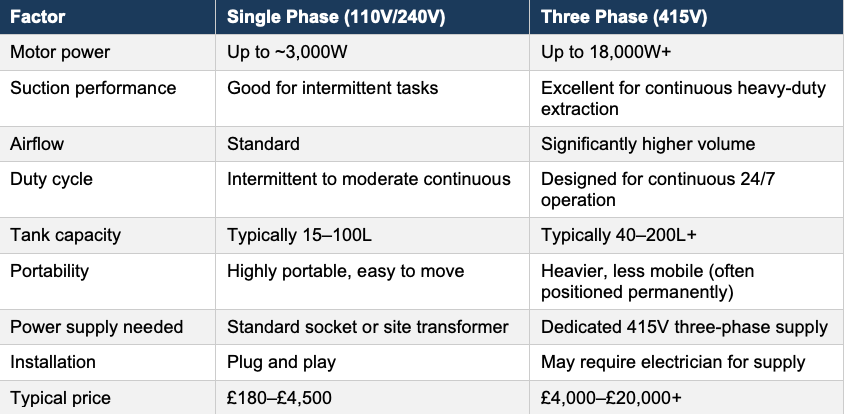
Three-phase 415V power delivers the highest performance available in industrial vacuum equipment. The three-phase electrical supply allows motors to be significantly more powerful than single-phase equivalents while actually running more efficiently. This translates directly into higher suction, greater airflow, and the ability to handle heavier materials over longer distances.
Three-phase vacuums are designed for continuous operation – running across full shifts, multiple shifts, or 24/7 in production line applications. CFM stocks three-phase vacuums from the full Nilfisk range including the likes of T40W, VHW, CTS range VHB436, and flagship 3707 and 3907 series. Prices typically range from £4,000 to over £20,000 depending on specification.
Performance Comparison
When Single Phase Is the Right Choice
Single-phase vacuums are the practical choice in several common scenarios. Construction sites where 110V safety supply is mandatory and portability between work areas is essential. Workshops and small manufacturing units with intermittent cleaning needs and no three-phase supply. Maintenance cleaning where the vacuum moves between locations rather than running continuously in one place. Budget-sensitive applications where the cleaning demand does not justify the higher cost of three-phase equipment.
For many businesses, a quality single-phase industrial vacuum handles their needs perfectly well. The Nilfisk S3 range, for example, offers genuine industrial build quality, L-class filtration, wet and dry capability, along with various filter cleaning options in a portable single-phase package.
When Three Phase Is Essential
Three-phase becomes essential when your application demands continuous operation across full shifts or around the clock. Production line integration where the vacuum runs alongside manufacturing processes. High-volume extraction of heavy materials like metal swarf, concrete dust, or large quantities of fine powder. Long-distance extraction where suction must be maintained across extended hose runs. Food manufacturing, pharmaceutical production, and other regulated environments where consistent, high-performance extraction is a compliance requirement.
In these scenarios, a single-phase machine will either underperform or fail prematurely. Three-phase motors are engineered for exactly this kind of sustained, demanding workload.
The Power Supply Question
Three-phase 415V supply is standard in most many UK industrial premises – factories, production facilities, and larger workshops typically have three-phase distribution boards. However, not all areas within a facility may have three-phase outlets available, and some smaller or older premises may only have single-phase supply throughout.
Before committing to a three-phase vacuum, verify that a suitable supply exists where the machine will be used. If not, installing a three-phase outlet is typically a straightforward job for a qualified electrician, but it is a cost and lead time to factor into your decision.
Battery-Powered Industrial Vacuums – The Complete Guide →
Total Cost of Ownership
Three-phase vacuums cost more upfront, but the total cost of ownership comparison is more nuanced than the price tag suggests.
Three-phase motors are inherently more energy-efficient than single-phase equivalents for the same power output. They also last longer under continuous use because the electrical and mechanical stresses are distributed more evenly. Maintenance costs tend to be lower per operating hour because the machines are built for sustained duty from the outset.
A single-phase vacuum pressed into continuous service will consume more energy relative to its output, wear out faster, and require more frequent servicing or replacement. If your application genuinely demands continuous heavy-duty extraction, a three-phase machine will almost always be more economical over its working life.
For intermittent applications, single-phase wins on both upfront and ongoing cost. The key is matching the machine to the actual duty it will perform.
Making the Decision
The decision framework is straightforward. Ask yourself three questions. First, does your application require continuous operation or high-volume extraction? If yes, three phase. Second, do you have three-phase power available where the machine will be used? If not, consider battery or check whether installation is practical. Third, is portability a primary requirement? If the machine needs to move frequently between locations, single phase or battery will be more practical.
For the many applications that fall between these extremes, CFM’s team can help you assess the right balance of performance, portability, and cost. A free site visit puts an expert in your facility to evaluate your specific needs.
✔ Free site visit — we’ll assess your facility and recommend the right solution
✔ Call us — 01677 426699 for immediate expert advice
✔ View our range — 75+ Nilfisk industrial vacuums in stock
Request Free Site Visit | View Industrial Vacuum Range | Call 01677 426699