Industrial Vacuum Buying Guide: Selecting the Right Equipment
Buying an industrial vacuum is not like buying most other equipment. The range of types, power sources, filtration classes, and specialist configurations means that the selection process involves more variables than most buyers expect. Choose well and the machine will serve you reliably for years. Choose poorly and you face underperformance, premature failure, compliance issues, or an expensive machine that is simply wrong for the job.
This guide walks you through the selection process step by step, from assessing your application through to making the final purchase decision. Whether you are replacing existing equipment, equipping a new facility, or buying your first industrial vacuum, this framework will help you arrive at the right specification.
Step 1: Define What You Are Collecting
Start with the material. Everything else in the specification follows from this.
Dry dust and debris is the most common starting point: general factory dust, workshop sweepings, production waste. Standard wet and dry vacuums handle this well. If the dust is hazardous (silica, hardwood, MDF, metal dust), you need classified equipment – M-class minimum, H-class for carcinogens and asbestos.
Liquids require wet and dry capability with appropriate tank construction, float valve protection, and drain facilities. Oils and cutting fluids need specialist oil recovery vacuums with separation systems that recover reusable fluid. Combustible materials (flour, sugar, wood dust, metal powder) require ATEX-certified equipment or ACD (Appliance for Combustible Dust) designated machines – certifications that are separate from the L/M/H dust classification.
If you handle multiple material types across your facility, you may need different machines for different areas or applications. A single machine rarely covers every need in a complex operation.
Dust Classification Guide – L, M and H Class →
ATEX Industrial Vacuum Guide →
Step 2: Assess Volume and Duty Cycle
How much material will the vacuum collect per shift? A workshop that generates a handful of dust per day has fundamentally different needs from a production line that fills a 100-litre tank every few hours.
Tank capacity determines how often the machine needs emptying. Small tanks (15–30 litres) are fine for intermittent cleaning. High-volume applications need 50–100+ litres to avoid constant interruptions. For context, a busy CNC workshop can generate several litres of cutting oil and swarf per machine per shift – multiply that across a shop floor of machines and the volume adds up quickly.
Duty cycle determines the power source and build quality required. Intermittent use (a few hours per day) suits single-phase equipment. Continuous operation (full shifts, multiple shifts, 24/7) demands three-phase motors rated for sustained duty. Underspecifying on either front is a false economy. A machine that runs out of capacity mid-shift or overheats from continuous use costs more in downtime and replacement than specifying correctly from the outset.
Step 3: Survey Your Environment
The operating environment constrains your options in ways that are easy to overlook.
Power supply
What voltage is available where the machine will operate? Three-phase 415V is standard in most UK factories but not all areas of a site may have outlets. Single-phase 110V is mandatory on construction sites. If no electrical supply is available or permitted, you need battery or compressed air power.
Floor space and access
Where will the machine be stored and used? Large three-phase vacuums with 100+ litre tanks require more floor space than compact single-phase units. Can the machine physically fit through doorways, aisles, and between equipment? Will it need to travel across ramps or between floors?
Environmental conditions
Temperature extremes, persistent moisture, outdoor exposure, corrosive chemicals, and explosive atmospheres all influence machine specification. A vacuum operating in a food production washdown area has different material requirements from one in a dry workshop.
Noise
Some environments have noise restrictions or neighbour-sensitive locations. While industrial vacuums are inherently louder than domestic machines, noise levels vary significantly between models and power sources.
Step 4: Check Compliance Requirements
Your regulatory obligations will narrow the field significantly – and rightly so.
COSHH requires classified vacuum equipment (L/M/H class) for hazardous dust. Your risk assessment should specify what class is needed for each material present. DSEAR requires ATEX-certified vacuum equipment in environments with combustible dust or flammable vapours – your DSEAR risk assessment and zone classification determine the certification required. ACD (Appliance for Combustible Dust) designation may also be appropriate depending on the circumstances. Food safety standards (BRC, SALSA) require equipment suitable for food production environments – typically stainless steel construction with hygienic design. Pharmaceutical GMP requires validated equipment with documented filtration performance and containment integrity. Construction site regulations may specify M-class extraction as minimum for certain materials and require 110V equipment for site safety.
Never compromise on compliance to save on budget. The cost of regulatory non-compliance – in fines, enforcement action, and reputational damage – far exceeds the cost of correctly specified equipment.
Step 5: Determine Your Budget and Acquisition Method
Industrial vacuums range from under £200 for commercial-grade wet and dry units through to over £20,000 for heavy-duty three-phase systems. Establishing a realistic budget early in the process prevents time wasted evaluating equipment that is either insufficient or unnecessarily expensive.
Remember that purchase is not the only option. CFM offers four acquisition routes: outright purchase for known long-term needs, short-term hire for projects, seasonal peaks, or trialling equipment, leasing for spreading cost with tax advantages, and contract hire for all-inclusive packages with servicing included. The right acquisition method depends on your financial situation, operational certainty, and maintenance preferences.
Step 6: Evaluate Total Cost of Ownership
The purchase price is a one-time cost. Total cost of ownership includes energy consumption over the machine’s working life, filter and consumable replacement costs, servicing and maintenance expense, downtime cost when the machine is out of service, and expected lifespan before replacement is needed.
A cheaper machine that consumes more filters, requires more frequent servicing, and lasts three years instead of eight is not a saving. Total cost analysis almost always favours well-specified, industrial-grade equipment for genuine industrial applications.
Quick Reference: Application to Vacuum Type
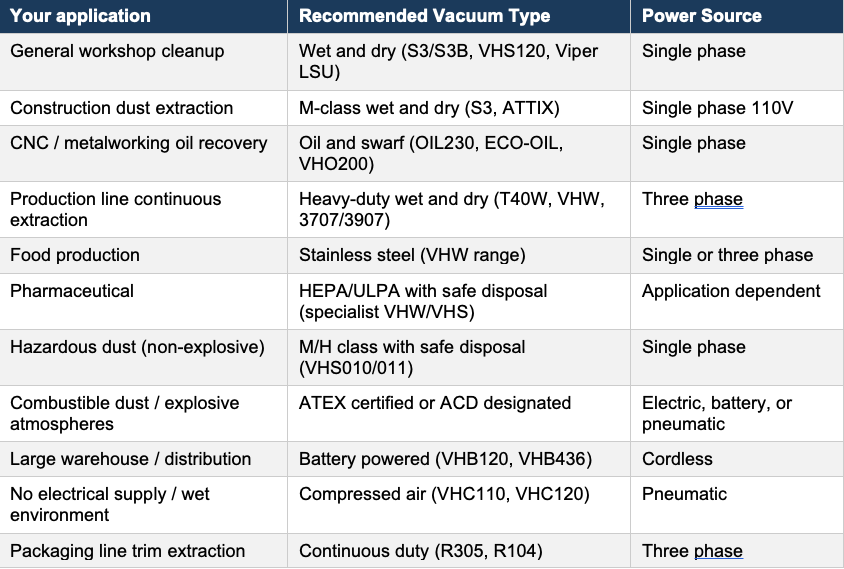
This table provides a starting point for matching your application to a vacuum category. Within each category, the specific model depends on your volume, duty cycle, compliance requirements, and environment.
Questions to Ask Your Supplier
The quality of your supplier matters as much as the quality of the equipment. Here are the questions that separate a knowledgeable specialist from a box-shifting e-commerce operation – and why each one matters.
What specific machine do you recommend for my application, and why?
A good supplier will ask detailed questions about your operation before recommending a machine. If they suggest a product without understanding your application, they are guessing.
Can you supply test certificates for the machine’s dust classification?
Genuine M-class and H-class certification comes with third-party test documentation. If the supplier cannot provide it, question whether the machine is truly classified.
Is the machine available for a site demonstration before purchase?
This is standard practice for specialist industrial equipment. A supplier who cannot or will not demonstrate the machine in your environment may not have the stock or expertise they claim.
What servicing and maintenance support do you offer?
Industrial vacuums need professional servicing. A supplier who only sells and does not service is leaving you to find aftermarket support – which may mean non-genuine parts and untrained technicians.
Do you stock genuine replacement filters and parts?
Ongoing consumable availability is critical. Check that the supplier can provide genuine parts on reasonable lead times, not just at point of sale.
Can you provide hire, lease, or contract hire options?
Flexibility in acquisition method indicates a supplier who understands that different businesses have different financial requirements. Purchase-only suppliers limit your options.
What is your experience with my specific industry or application?
A supplier who has equipped similar facilities to yours will understand the specific challenges, compliance requirements, and practical considerations that a generalist may miss.
Common Buying Mistakes to Avoid
Buying on price alone is the most common and most costly mistake. The cheapest machine is rarely the most economical over its working life, and may not meet your compliance requirements.
Overspecifying is as wasteful as underspecifying. Buying a £15,000 three-phase system for a job that a £2,500 single-phase unit handles perfectly ties up capital unnecessarily.
Ignoring duty cycle catches many buyers out. A machine rated for intermittent use will not survive continuous operation, regardless of how well-built it is. Check the duty cycle rating against your actual usage pattern.
Assuming HEPA means classified is a dangerous misconception. A HEPA filter in a non-certified machine does not make it M-class or H-class. Only whole-machine third-party certification counts.
Not checking power supply before ordering is more common than you might think. Discovering your facility lacks three-phase power after a £6,000 machine arrives is an expensive mistake that delays your project.
Forgetting ongoing costs leaves many buyers surprised. Filters, servicing, energy, and consumables are recurring costs that should be factored into the purchase decision from the outset.
✔ Free site visit — we’ll assess your facility and recommend the right solution
✔ Call us — 01677 426699 for immediate expert advice
✔ View our range — 75+ Nilfisk industrial vacuums in stock
Request Free Site Visit | View Industrial Vacuum Range | Call 01677 426699