
Industrial Vacuum Cleaner for Oil
An industrial vacuum cleaner for oil is a specialist machine built to recover cutting oils, coolant emulsion, and metal swarf from machine tools and workshop floors.
Unlike a standard wet and dry vacuum, an oil recovery unit separates liquid from solid through macrofiltration, allowing the recovered coolant to be pumped straight back into your CNC machine for reuse.
For engineering workshops running multiple machine tools, this single capability often pays for the vacuum within months.
CFM North East stocks the full Nilfisk OIL range. We supply across Yorkshire, the North East, and nationwide, with sales, hire, leasing, and full servicing support from our Bedale base.
Get an oil recovery vacuum quote
Trusted equipment suppliers to leading brands







Why standard industrial vacuums fail for oil recovery
Standard industrial vacuums are not designed to handle cutting oil or coolant. Three problems show up quickly.
Filters clog. Conventional dust filters saturate the moment they meet oil, killing suction and requiring constant replacement. Within weeks the consumable cost outstrips the vacuum itself.
Recovered fluid is wasted. Without a separation system, the cutting oil pulled into the tank is contaminated with swarf and unusable. You are paying twice: once for the cutting fluid you have lost, and again for the disposal of the contaminated waste.
Motors get damaged. Most general-purpose units lack the liquid cut-off mechanisms and corrosion-resistant components needed for sustained oil and coolant work. Premature motor failure is common.
A purpose-built oil recovery vacuum addresses all three.
How an oil recovery vacuum works
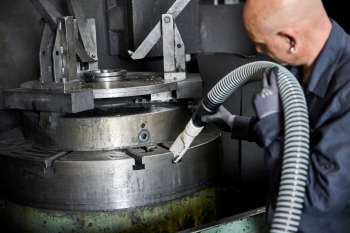
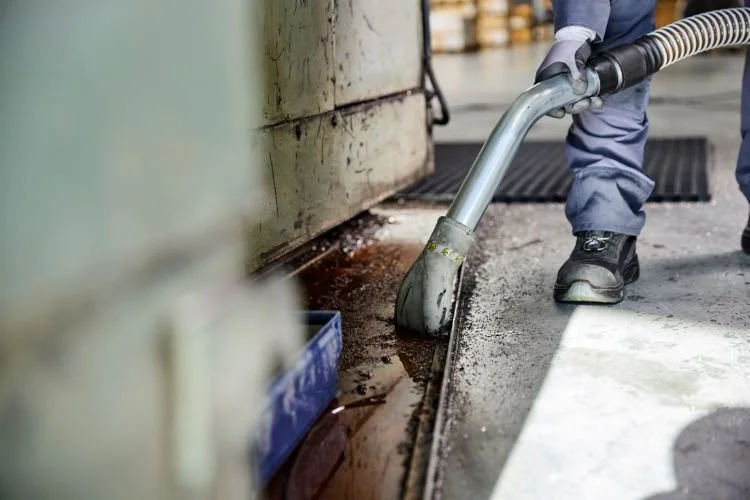
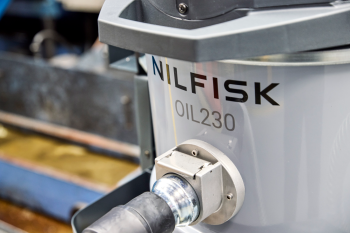
The principle is separation. The vacuum draws cutting oil, coolant, and metal swarf through a standard suction hose. Inside the machine, the mixture passes through a macrofiltration system: solids are caught in a removable basket, liquid falls into the main tank.
From there, an integrated discharge gun or pump allows the operator to send the recovered coolant straight back into the machine tool reservoir. Because the fluid retains its cutting properties, it can be reused immediately. The swarf, now relatively dry, is far easier to handle, store, and sell on for scrap.
The entire cycle of suction, separation, and return happens in a single continuous operation. An electrical liquid cut-out protects the motor when the tank reaches capacity.
What to look for when choosing an industrial vacuum for oil
Tank capacity. Small workshops with one or two machines can run a 20 to 30 litre unit comfortably. Multi-machine production environments need 50 to 100 litres or more to avoid constant emptying.
Separation method. Macrofiltration with a swarf basket is the standard for engineering applications. Check the basket is removable, easy to empty, and sized for your typical swarf volume.
Discharge mechanism. A pump or gun for returning coolant directly to the machine is what makes the economic case work. Without it, you are still moving fluid manually.
Power supply. Single-phase suits smaller workshops. Three-phase is standard for production environments running continuous duty cycles.
Build quality. Oil and coolant are aggressive. Stainless steel components, sealed motors, and quality hoses are the difference between a unit that lasts ten years and one that fails in two.
Which industries use industrial vacuums for oil?
The primary users are engineering and metalworking operations, but the application list is broader than most people realise. We provide oil recovery vacuum cleaners to a wide range of industries including:
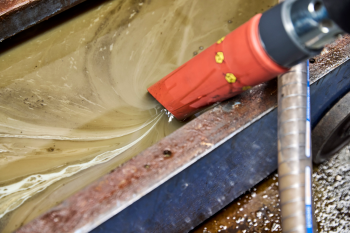
CNC machining centres. Metal chips and spent coolant accumulate in the machine bed and coolant tank. Regular extraction keeps coolant nozzles clear and extends fluid life.
Manual lathes and milling machines. Long stringy swarf from turning and heavier chips from milling both lift cleanly while the cutting oil is recovered for reuse.
Coolant tank maintenance. Over time, CNC coolant tanks build up sludge: fine metal particles, biological growth, and degraded coolant. An oil recovery vacuum strips the tank, separates reusable fluid, and removes the waste.
Automotive workshops. Engine oil spills, gearbox fluid, and brake fluid recovery all sit within scope.
Food production. Oil-based ingredient recovery and equipment cleaning around fryers and conveyor lines.
General workshop housekeeping. Any environment where oil, coolant, or hydraulic fluid is part of daily operations.
Popular industrial vacuums for oil
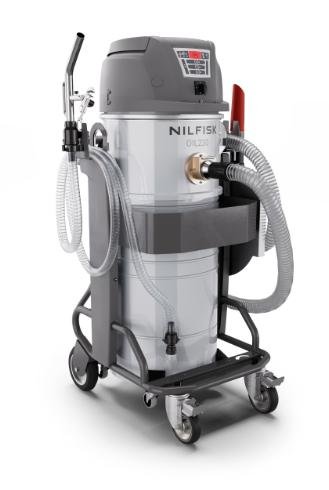
List price £5,894.95
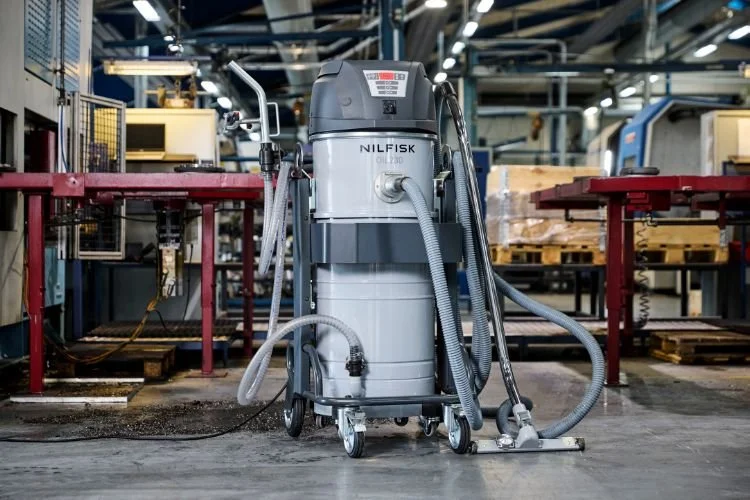
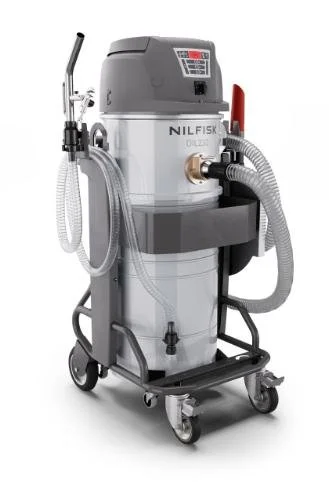
Built to keep moving, the OIL230 drives nonstop performance with simultaneous vacuum and discharge—streamlining every step of chips and oil recovery. This machine is made for reliability—and more importantly, so is your operation. The OIL230 is the new standard in metal chip collection and coolant recovery.
Durable, portable, and user-friendly industrial vacuum
Designed for metalworking applications
Boosts productivity during coolant recovery and chip separation
Enables continuous cleaning with minimal downtime
Enhances worker safety
Preserves product quality
Maximizes reuse of valuable resources
*Complete Box - standard toolkit included.
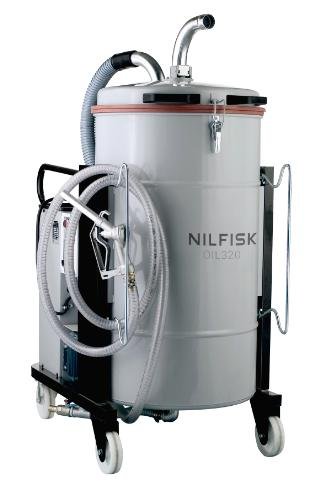
List price £9,003.08
The OIL series is indispensable equipment in the engineering industry where machine tools are used. The main function is to separate the lubricant/oil/coolant from the metal swarf and recover the liquid.
CNC machine tools use large volumes of costly coolant/oil that must be reused
OIL series enables fast and efficient coolant and oil recovery
Swarf is separated and retained in a basket
Liquids flow into the main tank for collection
Electrical liquid level cut-out stops the motor at maximum fill level
Recovered coolant is re-injected into the machine via a discharge gun
Vacuuming and re-discharge can occur simultaneously
Preserves oil and coolant properties
Reduces operating costs while ensuring high-quality machining results
Hire or buy, we have you covered.
For most engineering operations the right answer is buy or lease, because oil recovery is a daily requirement and the fluid savings compound month after month. Ownership makes the economics work.
Hire suits three scenarios. The first is a short-term project, such as a one-off coolant tank clean-out or a contractor working on site for a fixed period. The second is a trial: testing whether an oil recovery vacuum suits your operation before committing. The third is bridging a gap while a purchased unit is on order or in service.
Contract hire and leasing both spread the cost over 12 to 60 months with servicing included, which keeps capital expenditure off the balance sheet while delivering the same coolant savings from day one.
Our recommended industrial vacuums for oil
At CFM North East we stock the full Nilfisk OIL range. Each model is purpose-built for the engineering industry.
Nilfisk ECO OIL 13. Compact unit suited to smaller workshops with one or two machines. Includes liquid recovery gun for direct return to the machine tool.
Nilfisk ECO OIL 22. Stepped-up capacity for busier workshops handling continuous swarf and coolant. Same separation principle, larger tank.
Nilfisk OIL 230. The workhorse of the range. Standard workshop oil and swarf recovery duties across multiple machines.
Nilfisk ECO-OIL 310 and ECO-OIL 320. Higher capacity units for larger operations with multiple machines to service. Oil separation and recycling capability built in.
Nilfisk VHO 200. Compact option where floor space is at a premium but specification cannot be compromised.
Pricing depends on configuration, accessories, and whether you are buying, hiring, or leasing. We will give you a clear all-in quote rather than a starter price that grows.
Our services are rated 5/5 with Google
Don't just take our word for it, our customers consistently rate us five stars for product knowledge, honest advice, and reliable after-sales support.
Industrial vacuum Cleaner for Oil FAQs
-
No, not for sustained use. Standard wet and dry vacuums lack the separation system needed to recover reusable coolant, and their filters clog rapidly when exposed to oil. They will work for a one-off spill but will not pay back the investment in a workshop setting.
-
It depends on your machining volume, but workshops typically recover 70 to 90% of cutting fluid that would otherwise be discarded with swarf. For a single CNC machine using 50 litres of coolant per month, that is a meaningful annual saving on fluid replacement alone, before disposal costs.
-
The macrofiltration system separates out solid swarf, which is the main contaminant. For most workshop applications the recovered fluid can be returned directly to the machine. For longer-term coolant management, periodic skimming or treatment may be appropriate depending on your process.
-
Annual servicing is the standard recommendation for daily-use machines. High-volume operations may need six-monthly checks. Operators should also inspect filters, seals, and the swarf basket regularly between services
-
Yes. CFM offers daily, weekly, and monthly hire on the Nilfisk OIL range, with delivery across Yorkshire, the North East, and the wider UK. Useful for one-off coolant tank cleans, contractor work, or trialling a unit before purchase.
-
Yes, for environments with flammable oil mist or combustible dust risk. ATEX-rated vacuum cleaner units carry additional certification and design features. Specification depends on the zone classification of your environment. We can advise on the right configuration.
Why our customers choose CFM North East
Over 25 years supplying industrial cleaning equipment to engineering, manufacturing, and metalworking sites across Yorkshire, the North East and throughout the UK.
Approved Nilfisk partner with access to the full OIL range.
Sales, hire, leasing, and servicing handled from one team.
Free on-site demonstrations and full operator training
Ongoing technical support.
Get an oil recovery vacuum quote