
Choosing a Scrubber Dryer by Flooring Type
The correct machine and whether a pad or brush set-up is used depends on your flooring type and configuration. Sealed concrete, tiles with grouting, resin, safety flooring, vinyl and polished surfaces each need a particular approach, and the wrong pad or brush can damage a sensitive floor as easily as it can fail to clean a robust one.
Why does flooring type matter more than the machine?
Two facilities can buy the same machine and get very different results, because the deck set-up is what meets the floor. A pad that gives an excellent finish on smooth resin will skate over the texture of safety flooring without cleaning it. A stiff brush that cleans safety flooring beautifully can mark a polished surface.
Getting the machine size and format correct is a productivity decision. Getting the brush or pad and downward pressure correct is a quality and floor protection decision, and it is the one more often overlooked.
Sealed and power-floated concrete
Sealed concrete is the most common industrial floor, found across warehousing, manufacturing and distribution. It is hard-wearing and tolerates robust cleaning, which makes it comparatively straightforward.
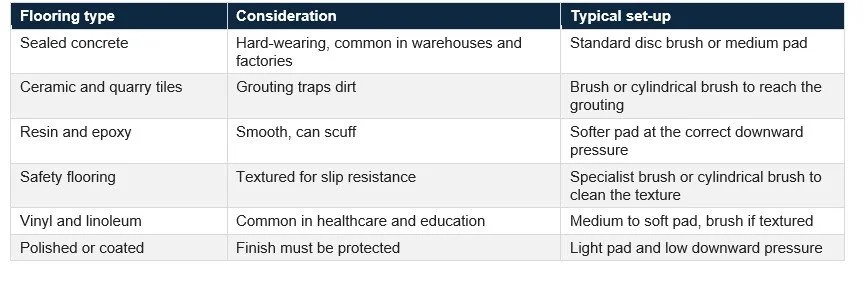
A standard disc brush or a medium pad suits most sealed concrete. The main complications are tyre marks from forklift and pallet truck traffic, which need adequate downward pressure to lift, and loose grit, which is better swept before scrubbing to protect the deck and the squeegee blades.
Ceramic and quarry tiles
Tiled floors present a particular problem: the tile surface may be smooth but the grouting sits below it and traps dirt. A flat pad rides across the tile face and never reaches the grout lines, so the floor looks clean while the grouting darkens over time.
A brush is the correct choice here, and a cylindrical brush configuration reaches into grouting more effectively still. This is why tiled kitchens, washrooms and food preparation areas are so often specified with a cylindrical machine.
Resin and epoxy
Resin and epoxy floors are smooth, seamless and generally hard-wearing, but the surface finish can scuff and dull if cleaned too aggressively. They are common in food production, pharmaceutical facilities and modern industrial units.
A softer pad at the correct downward pressure is usually appropriate. The aim is to clean the surface without abrading the finish, so it is worth confirming the pad grade rather than assuming the most aggressive option will simply clean better.
Safety flooring
Safety flooring is deliberately textured to provide slip resistance, which is exactly what makes it difficult to clean. The texture that grips a shoe also grips dirt, and a flat pad cannot reach into it.
A specialist brush or cylindrical brush is needed to clean the texture properly. Where safety flooring is used across a facility, a cylindrical configuration is often the deciding factor in machine selection, because it works into the surface rather than skimming across it.
Vinyl and linoleum
Vinyl and linoleum are common in healthcare, education and retail. Both clean well with a scrubber dryer, but both can be damaged by over-aggressive pads and by excessive water if the floor is not properly sealed at the joints.
A medium to soft pad generally gives the best balance of cleaning and finish. Where the vinyl is textured or has a safety finish, treat it as safety flooring and use a brush.
Polished and coated floors
Polished concrete, sealed timber and coated floors carry a finish that is part of the floor's appearance and its protection. Aggressive cleaning removes that finish, which is expensive to restore.
A light pad and low downward pressure is the correct approach. The aim is maintenance cleaning that preserves the finish rather than cutting into it.
Which set-up suits which floor?
What if a facility has several flooring types.
Most do, and it is one of the more common reasons a single machine disappoints. A warehouse with sealed concrete, a tiled canteen, safety flooring in the wash-down area and vinyl in the offices is asking one deck to do four different jobs.
There are two workable answers. Either change the consumable between areas, which is practical if the areas are cleaned at different times, or specify more than one machine. A wide variety of requirements exist within most facilities, and different machines are often required for different elements of production, logistics and offices. Good advice and quite often a site visit are beneficial in identifying what is genuinely needed.
Let us look at your floors before you specify
Flooring type and configuration decide the set-up, and photographs rarely tell the whole story. We will assess your floors in person and demonstrate the correct set-up on your own surfaces, with no obligation.
Call CFM on 01677 426699 or request a no obligation demonstration online.