
How to Size a Scrubber Dryer for Your Facility
The correct size of scrubber dryer is the machine whose scrub width and tank capacity clean your floor within the time available, without constant stops to refill and empty, and which physically fits everywhere it needs to go. Bigger is not automatically better, because a machine that cannot pass through a doorway or turn in an aisle will not clean the floor at all.
What are the three variables that decide size?
Scrub width
Scrub width is the width of floor the machine cleans in a single pass. A wider deck covers more ground per pass and therefore cleans faster, but it also makes the machine larger and less able to manoeuvre in tight areas.
Tank capacity
Tank capacity determines how long the machine can work before the solution tank is empty and the recovery tank is full. Larger tanks mean fewer interruptions, which matters a great deal on big floors where the walk to the nearest drain and tap is long.
Productivity
Productivity, expressed in square metres per hour, ties the other two together. It is the figure that tells you whether a machine can realistically clean your floor in the window available.
Why is real-world productivity lower than the quoted figure?
Quoted productivity figures are theoretical. They assume the machine cleaning continuously in a straight line at full width with no interruptions, which never happens in practice.
Real-world productivity is reduced by turning at the end of each run, manoeuvring around racking, pallets, furniture and people, overlapping passes, stopping to refill and empty tanks, and cleaning edges and corners. As a general planning rule it is sensible to assume real output will be meaningfully below the theoretical figure, and to build that assumption into the specification rather than discovering it after purchase.
How do you work out the size you need?
Step 1: Measure the area to be cleaned
Measure the actual floor area that will be machine cleaned, not the total floor area of the building. Exclude racking footprints, fixed plant, carpeted areas and anywhere the machine cannot physically reach.
Step 2: Establish the cleaning window
Determine how long is genuinely available for cleaning, and how often the floor needs cleaning. A two hour nightly window and a four hour weekly window lead to very different machines.
Step 3: Work out the productivity required
Divide the area by the time available to find the square metres per hour the machine must achieve. Then allow a margin, because the theoretical figure will not be met in practice.
Step 4: Check the tank capacity against the run
Estimate how long the machine will run before the tanks need attention, and consider how far the operator must travel to a drain and a tap. On large floors, tank capacity often constrains productivity more than scrub width does.
Step 5: Check the machine physically fits
Measure the narrowest doorway, the tightest aisle, any lift the machine must use, and the storage space. Confirm the machine can reach every area on the cleaning route, and that it can be stored and charged safely.
What does this look like in practise?
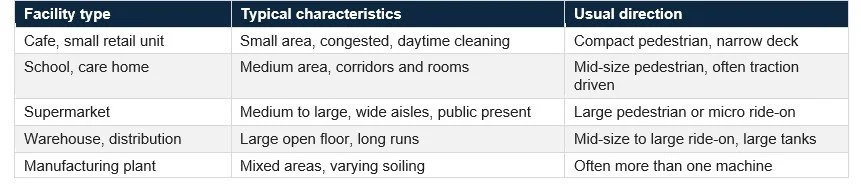
What happens if you size it incorrectly?
An undersized machine cannot finish the floor in the time available. Cleaning either overruns, which costs labour, or areas get missed, which defeats the purpose of buying the machine. Operators also stop more frequently to refill and empty, which is where much of the lost time goes.
An oversized machine causes different problems. It may not reach parts of the floor, it takes more space to store and charge, it costs more to buy and to run, and in congested areas an operator will often leave it standing rather than wrestle it into position. An incorrect choice of machine can be costly in terms of wasted labour or, worse still, may not complete the job to the required standard. Often, if the machine is incorrect, operators will not bother to use it and it will sit in the cupboard gathering dust.
Should the flooring type affect sizing?
It affects the specification alongside the size. The flooring type and configuration decide whether a brush or a pad drive is correct, and what downward pressure is appropriate. A heavily soiled or textured floor may need a slower, more thorough pass, which reduces effective productivity and can push the sizing towards a wider machine to compensate.
Let us size it against your actual facility
Sizing on paper is a useful starting point, but floors rarely behave as the plan suggests. We will assess your facility, confirm the machine fits everywhere it needs to reach, and demonstrate it on your own flooring with no obligation.
Call CFM on 01677 426699 or request a no obligation demonstration online.