Compressed Air Industrial Vacuums: When Pneumatic Is the Answer
In most industrial environments, vacuum cleaners run on electricity. But there are situations where electric motors are impractical, unsafe, or simply not permitted – and that is where compressed air (pneumatic) industrial vacuums become not just useful, but essential.
Pneumatic vacuums are one of the most overlooked categories in industrial cleaning equipment. There is remarkably little guidance available in the UK market, which means many buyers either do not know they exist or do not understand when they are the right solution. This guide fills that gap.
How Pneumatic Vacuums Work
Compressed air industrial vacuums use the Venturi principle to generate suction. Compressed air from your facility’s air supply is forced through a narrow nozzle inside the vacuum, creating a high-velocity airstream. As the air accelerates through the constriction, it creates a pressure drop in the surrounding area. This low-pressure zone draws in ambient air – and with it, dust, debris, and liquids – through the vacuum inlet.
The critical point: there are no electrical components whatsoever. No electric motor, no wiring, no switches, no sparks. The entire suction mechanism is powered by airflow alone. The only moving part in the suction system is the air itself.
This simplicity is both the defining strength and the key limitation of pneumatic vacuums. It eliminates electrical ignition risk entirely, but it also means suction performance is directly dependent on your compressed air supply – its pressure, flow rate, and consistency.
When Pneumatic Vacuums Are Essential
Explosive Atmospheres (ATEX Zones)
In environments classified under DSEAR as Zone 0, Zone 1, or Zone 20 – where explosive atmospheres are present continuously or frequently – even ATEX-certified electric motors may not be permitted depending on the specific zone and equipment category requirements. Pneumatic vacuums, with no electrical components at all, eliminate the ignition source entirely. They are the safest possible option in the most demanding explosive atmosphere classifications.
Nilfisk’s VHC110 Z1 EXA and VHC120 Z1 EXA are compressed air vacuums with ATEX Zone 1 and Zone 21 certification, designed for exactly these environments.
ATEX Industrial Vacuum Superguide →
Wet Environments
Environments where water, coolant, or other liquids are constantly present create obvious risks for electrical equipment. Pneumatic vacuums operate safely in wet conditions that would be dangerous or impractical for electric machines. This includes food processing washdown areas where high-pressure water is used routinely, marine and offshore environments with constant saltwater exposure, chemical processing areas where liquid spills are frequent, and any facility where electrical equipment near liquids creates an unacceptable safety risk.
No Electrical Supply Available
Some work locations simply do not have electrical supply – remote areas of large sites, temporary installations, outdoor yards, or spaces within facilities that are too far from distribution boards. If compressed air is available (from a central compressor or portable unit), a pneumatic vacuum can operate without any electrical infrastructure.
Hazardous or Sensitive Environments
Certain pharmaceutical, chemical, and research environments restrict or prohibit electrical equipment in specific zones. Pneumatic vacuums provide cleaning capability without introducing any electrical risk into these controlled areas.
Compressed Air Supply: What You Need to Know
Pneumatic vacuums are only as effective as the air supply feeding them. Understanding the supply requirements before selecting a machine prevents the most common problems: underwhelming performance caused by inadequate air pressure or flow.
Operating Pressure
Most pneumatic industrial vacuums require an operating pressure between 4 and 7 bar. This is within the range of most industrial compressed air systems, but you should verify the actual delivered pressure at the point of connection, not just the compressor’s rated output. Pressure drops across long pipe runs, through regulators, and at connection points can reduce the delivered pressure significantly.
Air Consumption
This is the factor most often underestimated. Pneumatic vacuums consume substantial volumes of compressed air during operation – typically measured in litres per minute (l/min) or cubic metres per hour (m³/h). A Venturi-based vacuum can consume 200–500+ l/min depending on the model and nozzle configuration. Before installing a pneumatic vacuum, verify that your compressor has sufficient spare capacity to run it alongside all other pneumatic equipment on the same circuit. An undersized compressor will result in system-wide pressure drops that reduce vacuum performance and may affect other tools and processes sharing the supply.
Air Quality
Compressed air quality matters for pneumatic vacuums, particularly in sensitive environments. Moisture in the air supply can cause internal corrosion over time. Oil carryover from lubricated compressors can contaminate the vacuum and the materials being collected. In pharmaceutical or food environments, air quality standards may dictate the use of filters, dryers, and oil-free compressors on the supply line feeding the vacuum.
CFM’s Compressed Air Range
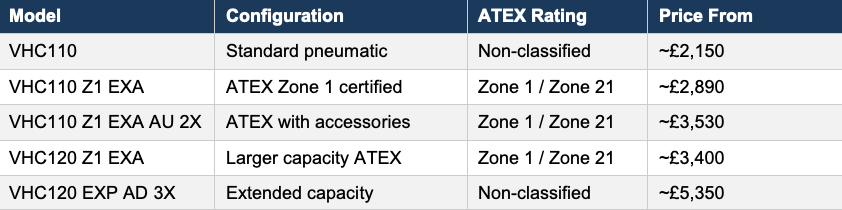
The VHC110 is the standard-capacity unit suited to most applications. The VHC120 steps up tank capacity for larger jobs. Both are available in ATEX Zone 1/Zone 21 certified variants for explosive atmosphere applications, and the non-classified versions serve environments where electrical power is simply unavailable or impractical rather than prohibited.
Advantages and Limitations
Advantages
Zero electrical components eliminate ignition risk entirely – the single most important advantage for explosive atmosphere applications. Pneumatic vacuums operate safely in wet and even submerged environments. They require no electrical installation or power points. Construction is mechanically simple with fewer components to maintain – no motor brushes, no capacitors, no electrical safety testing required. ATEX certification extends to the highest zone classifications because there is no electrical ignition source to manage. They are also suited to continuous operation without the overheating risks that can affect electric motors.
Limitations
Lower energy efficiency is the primary trade-off. Compressed air is one of the most expensive forms of energy in a factory – generating it requires a compressor running an electric motor, with significant energy losses in compression, cooling, and distribution. This means the cost per hour of operating a pneumatic vacuum is typically higher than an equivalent electric machine.
Suction performance per unit of energy input is lower than electric equivalents. The Venturi principle, while effective, does not convert air energy into suction as efficiently as a direct-drive electric motor.
Noise levels can be higher than electric vacuums due to the air exhaust, particularly in enclosed spaces. Silencers are available to mitigate this, but pneumatic vacuums are inherently louder than well-damped electric units.
The requirement for compressed air infrastructure means these machines are only practical in facilities that already have a compressor and distribution system, or where a portable compressor can be positioned nearby.
Running Cost Comparison
The higher operating cost of pneumatic vacuums compared with electric equivalents is a legitimate consideration. However, cost should be assessed in the context of what the pneumatic vacuum makes possible.
In an explosive atmosphere where electric vacuums are not permitted, the alternative to a pneumatic vacuum is not a cheaper electric one – it is either no vacuuming at all (creating safety and housekeeping problems) or ATEX-certified electric equipment that may cost significantly more than the pneumatic equivalent.
In wet environments where electrical safety is a concern, the cost of a pneumatic vacuum is offset against the risk management cost of using electrical equipment in proximity to liquids – including potential injury, liability, and insurance implications.
For general-purpose cleaning where no safety constraint mandates pneumatic operation, electric vacuums will almost always be more cost-effective. Pneumatic vacuums are a specialist solution for environments where the specific safety advantages justify the operating cost.
Maintenance
Pneumatic vacuums benefit from mechanical simplicity. With no electric motor, there are no brushes to replace, no capacitors to fail, and no electrical safety testing to schedule. Maintenance focuses on checking air supply connections and hoses for leaks, inspecting and replacing filters on schedule, cleaning the Venturi nozzle to maintain optimal airflow, checking seals and gaskets for wear, and verifying that the compressed air supply is delivering adequate pressure and flow.
The absence of electrical components means that maintenance can often be performed by facilities staff without requiring an electrician. However, ATEX-certified models should only be serviced by personnel trained in ATEX vacuum equipment maintenance to ensure the integrity of the certification is maintained.
Pneumatic vs Electric: Making the Right Choice
Pneumatic vacuums are not a general-purpose replacement for electric machines. They are a specialist solution for environments where electric power is unsuitable, unavailable, or prohibited. In those environments, they are irreplaceable.
For facilities where electric vacuums can operate safely and practically, they will almost always be more efficient and cost-effective. The decision is driven by environment and safety requirements, not by general preference.
If you are unsure whether your application requires pneumatic equipment, CFM’s team can assess your environment and advise on the right power source. This is particularly important for ATEX-classified areas, where the choice of power source is determined by the zone classification and DSEAR risk assessment.
✔ Free site visit — we’ll assess your facility and recommend the right solution
✔ Call us — 01677 426699 for immediate expert advice
✔ View our range — 75+ Nilfisk industrial vacuums in stock
Request Free Site Visit | View Industrial Vacuum Range | Call 01677 426699