Hazardous Dust Industrial Vacuums: Beyond ATEX
When people think of hazardous dust and specialist vacuum equipment, ATEX certification often comes to mind first. But the majority of hazardous dust encountered in UK workplaces is not combustible – it is toxic. Silica from concrete cutting, asbestos during remediation, hardwood dust from joinery, lead paint during renovation, pharmaceutical active ingredients during manufacturing: all of these require specialist vacuum equipment, but none of them (in most circumstances) require ATEX certification.
What they do require is the correct dust classification – M-class or H-class – along with appropriate safe disposal systems to protect operators during waste removal. Getting this specification right is a COSHH obligation, and getting it wrong has serious health and legal consequences.
This guide covers the hazardous dust landscape beyond explosive atmospheres: what makes dust hazardous, what equipment you need, and how to ensure your vacuum extraction meets both the legal requirements and the practical realities of your operation.
What Makes Dust Hazardous?
Dust becomes a health hazard when it can be inhaled into the lungs and cause damage. The risk depends on the particle size (respirable particles below 10 microns penetrate deep into the lungs), the toxicity of the material (some substances cause immediate irritation, others cause long-term disease including cancer), the concentration of dust in the air (measured against Workplace Exposure Limits), and the duration of exposure (some substances are dangerous even at low concentrations over long periods).
The HSE’s EH40 document lists Workplace Exposure Limits (WELs) for over 500 substances. These are legally binding – employers must keep worker exposure below these limits. When a WEL exists for a substance present in your workplace, you need controls to meet it. Vacuum extraction with correctly classified equipment is one of the most effective controls available.
Common Hazardous Dusts and Their Classification
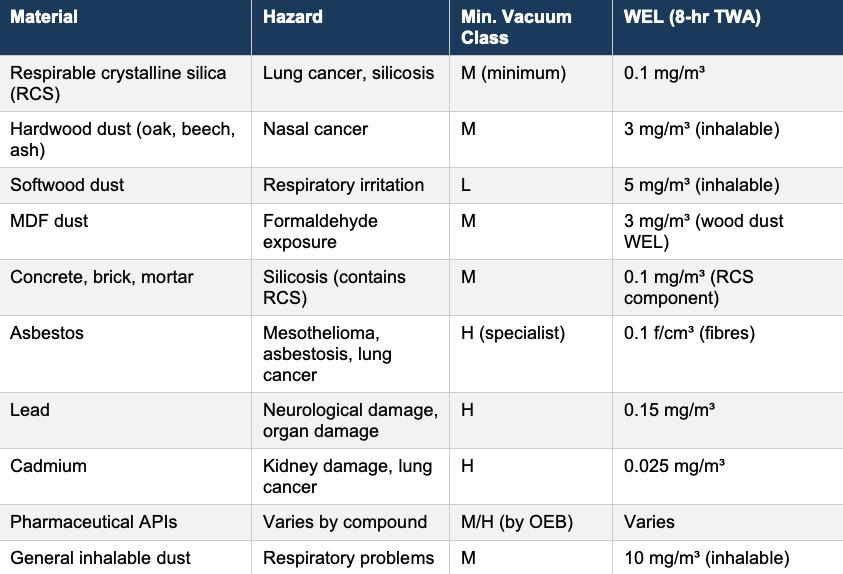
The most commonly encountered hazardous dust in UK workplaces is respirable crystalline silica (RCS), generated whenever concrete, stone, brick, or mortar is cut, ground, drilled, or demolished. The WEL of 0.1 mg/m³ is extremely demanding – this is an invisible quantity of dust that can only be measured with specialist monitoring equipment. M-class extraction at the point of generation is the HSE’s expected baseline control for silica exposure.
M-Class vs H-Class: Choosing the Right Level
M-class industrial vacuums are the practical standard for the majority of hazardous dust applications. They provide filtration to ≤0.1% leakage, mandatory airflow monitoring to warn when suction drops below safe levels, and safe disposal systems to prevent dust release during emptying. M-class covers hardwood, concrete, silica, MDF, metal dust, and most other medium-hazard materials encountered in construction, manufacturing, and joinery.
H-class is required for the most dangerous materials: asbestos, carcinogenic substances, lead, cadmium, and certain pharmaceutical actives. H-class provides filtration to ≤0.005% leakage (twenty times tighter than M-class), dust-free filter replacement to prevent operator exposure during maintenance, and enhanced safe disposal with sealed containment. Asbestos work carries additional legal requirements beyond just using H-class equipment, including licensed contractor requirements for most asbestos types.
Safe Disposal: The Often-Overlooked Critical Factor
Collecting hazardous dust is only half the problem. How you remove that dust from the vacuum without exposing operators is equally important – and it is the factor most often overlooked when specifying equipment.
Standard bag disposal involves opening the vacuum, removing a bag or container, and replacing it. With hazardous dust, this process can release concentrated dust directly into the operator’s breathing zone. For M-class and H-class applications, this is unacceptable.
Longopac Continuous Bagging
Nilfisk’s Longopac system dispenses a continuous tube of plastic liner material. When the collection section is full, the operator ties off the bag, cuts it, and a fresh section of liner is ready. The collected dust is sealed inside without being exposed to the operator or the environment. This is the standard safe disposal method for M-class applications.
HC (High Containment) Safe Bag System
For higher-hazard applications, the HC system provides an additional level of containment. The waste bag is sealed within a secondary containment envelope, providing double-bagged protection. This is particularly important for H-class materials and pharmaceutical applications where any exposure must be prevented.
LC (Low Containment) Systems
LC disposal provides basic contained disposal for lower-hazard applications. It is suitable for L-class and some M-class materials where the dust is unpleasant but not highly toxic.
CFM’s Hazardous Dust Range
CFM stocks the Nilfisk VHS010 and VHS011 Mini IVAC range specifically for hazardous dust applications. These are compact, highly portable machines that pack serious containment capability into a small footprint:
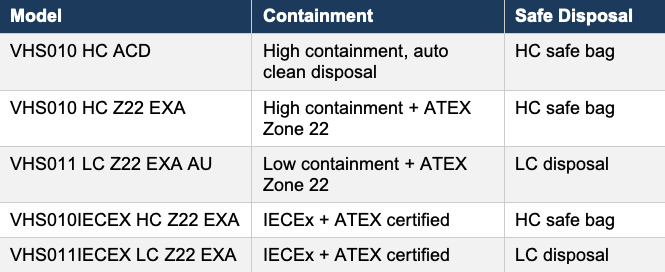
The VHS010 and VHS011 Mini IVAC range demonstrates a principle that runs through all of CFM’s specialist equipment: serious industrial capability does not require massive, unwieldy machines. These compact units are designed for point-of-use hazardous dust collection – at the workstation, at the tool, at the source of the hazard.
COSHH Compliance: Your Responsibilities
Using correctly classified vacuum equipment is one control measure within your broader COSHH obligations. A compliant approach also includes a current COSHH risk assessment identifying all hazardous substances and the controls required, training for operators on the hazards they are exposed to and how to use equipment safely, maintenance records demonstrating that vacuum equipment is serviced and performing to its certified standard, exposure monitoring where required to verify that controls are actually achieving the WEL, and health surveillance for workers exposed to specific substances such as silica and asbestos.
The vacuum is a critical part of this system, but it does not operate in isolation. It works alongside other controls including water suppression, LEV systems, RPE, and work method controls. CFM’s team can advise on the vacuum extraction element of your COSHH controls and how it integrates with your broader approach.
✔ Free site visit — we’ll assess your facility and recommend the right solution
✔ Call us — 01677 426699 for immediate expert advice
✔ View our range — 75+ Nilfisk industrial vacuums in stock
Request Free Site Visit | View Industrial Vacuum Range | Call 01677 426699