Industrial Vacuums for Pharmaceutical Production
Pharmaceutical manufacturing is the most demanding environment for industrial vacuum specification. The consequences of getting it wrong go beyond regulatory non-compliance – they extend to operator safety, product integrity, and patient health. A vacuum cleaner in a pharmaceutical facility is not just cleaning equipment. It is a containment system, a safety control, and a compliance tool.
This guide covers the key considerations for specifying vacuum equipment in pharmaceutical production environments, focusing on non-ATEX applications. If your facility handles combustible pharmaceutical dusts, you may also need ATEX-certified equipment, covered in our dedicated ATEX for Pharmaceutical Production article.
ATEX Vacuums for Pharmaceutical Production →
Why Pharmaceutical Manufacturing Is Different
Four factors set pharmaceutical vacuum requirements apart from any other sector.
Active Pharmaceutical Ingredients (APIs)
Many APIs are potent substances that pose serious health risks to operators who inhale or absorb them. Occupational Exposure Bands (OEBs) classify APIs by their potency, from OEB1 (low hazard, occupational exposure limit above 1,000 µg/m³) through to OEB5 (highly potent, exposure limit below 1 µg/m³). The OEB classification directly determines the containment level required from vacuum equipment.
For OEB3 and above, standard industrial vacuums – even M-class or H-class certified units – may not provide sufficient containment without additional engineering controls. The vacuum must prevent any exposure to the operator during collection, filter changes, and waste disposal.
GMP Compliance
Good Manufacturing Practice (GMP) regulations govern every aspect of pharmaceutical production, including cleaning. Vacuum equipment used in GMP-regulated areas must be validated for its intended purpose, meaning its filtration performance, containment integrity, and cleaning effectiveness must be documented and verified.
Constructed from materials that do not shed particles, corrode, or contaminate the product or environment.
Maintainable with documented service records that form part of the facility’s GMP documentation. Compatible with the facility’s cleaning validation protocols, including any clean-in-place or wipe-down procedures between product changeovers.
Cross-Contamination Prevention
Pharmaceutical facilities often manufacture multiple products, sometimes on shared equipment. Preventing cross-contamination between products is a fundamental GMP requirement. Vacuum equipment must either be dedicated to a single product or area, or be demonstrably cleanable to a validated standard between uses.
For high-potency compounds (OEB4-5), dedicated equipment is typically the only acceptable approach. The vacuum becomes part of the containment system for that specific compound and is never used elsewhere.
Cleanroom Compatibility
Many pharmaceutical production steps take place in classified cleanroom environments (ISO Class 5 through Class 8). Vacuum equipment operating in cleanrooms must not compromise the room’s particle count classification. This means the vacuum’s exhaust must be filtered to a standard that does not add particles to the cleanroom air – typically requiring HEPA H14 or ULPA filtration on the exhaust.
Filtration and Containment Requirements
Pharmaceutical vacuum filtration goes beyond the standard L/M/H classification system (though those classifications still apply as a baseline). The key considerations are primary filtration, where HEPA H14 (99.995% at MPPS) is the minimum standard for pharmaceutical applications, and ULPA is used for the most demanding cleanroom environments.
Exhaust filtration matters because the air leaving the vacuum must meet the cleanliness requirements of the production environment. In a cleanroom, this means the exhaust must be filtered to at least the same standard as the room’s supply air. Safe disposal is critical – how the collected material is removed from the vacuum without exposing the operator is often the most challenging aspect.
Longopac continuous bagging, HC safe bag systems, and sealed disposal containers each offer different levels of containment. Filter change safety is important because changing a saturated filter can release concentrated dust. H-class vacuums require dust-free filter replacement. For pharmaceutical applications, this requirement is even more critical when the filter may contain potent API residue.
Matching Equipment to OEB Classification
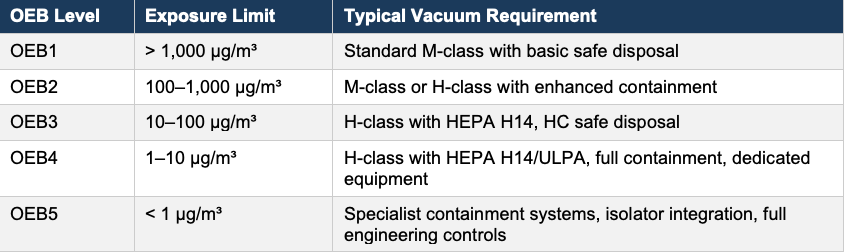
This table is a general guide. The specific vacuum specification for your application should be determined by your facility’s occupational hygienist and quality assurance team, based on the compounds being handled and the operational context.
Equipment Options
CFM stocks Nilfisk vacuum equipment suitable for pharmaceutical applications across the containment spectrum. For lower OEB levels (OEB1-2), the VHW stainless steel range provides food-grade construction with standard M-class or H-class filtration. For mid-range containment (OEB3), the VHS010 and VHS011 Mini IVAC range with HC safe disposal and HEPA H14 filtration offers compact, high-containment capability. For higher OEB levels, specialist configurations with ULPA filtration, full containment, and customised disposal systems are available on application.
The right specification depends on the specific compounds, processes, and regulatory framework of your facility. CFM’s team works with pharmaceutical customers to understand these requirements and match equipment accordingly – this is not an off-the-shelf purchase, and we treat it as such.
Validation and Documentation
In a GMP environment, the vacuum is not fully commissioned until it is validated. This typically includes Installation Qualification (IQ) confirming the equipment is installed correctly and matches the specification. Operational Qualification (OQ) confirming the equipment performs within specified parameters, including filtration efficiency, suction performance, and containment integrity. Performance Qualification (PQ) confirming the equipment performs reliably under actual production conditions over a defined period.
Documentation requirements include certificates of material compliance for product-contact surfaces, filtration test certificates, maintenance and service records, and cleaning validation protocols.
Nilfisk provides IQ/OQ documentation packages for their pharmaceutical-grade equipment. CFM can coordinate this documentation as part of the equipment supply and commissioning process.
Choosing a Supplier for Pharmaceutical Vacuums
This is not an area where you want to buy from a general equipment catalogue. Pharmaceutical vacuum specification requires genuine understanding of GMP requirements, containment principles, and the regulatory context of pharmaceutical manufacturing.
CFM North East has worked with pharmaceutical manufacturers to specify and supply containment-grade vacuum equipment. We understand that the conversation starts not with “which model do you want?” but with “what compounds are you handling, at what OEB, in what environment, and under what regulatory framework?”
✔ Free site visit — we’ll assess your facility and recommend the right solution
✔ Call us — 01677 426699 for immediate expert advice
✔ View our range — 75+ Nilfisk industrial vacuums in stock
Request Free Site Visit | View Industrial Vacuum Range | Call 01677 426699