Industrial Vacuum Filtration: HEPA, Cartridge and Safe Disposal Systems
Filtration is the component that defines what an industrial vacuum can safely collect, how well it protects operators and the environment, and how consistently it performs over time. Every other aspect of the machine – motor power, tank capacity, build quality – is meaningless if the filtration system is not appropriate for the application.
Yet filtration is also the area where the most confusion exists. HEPA labels are applied loosely. Filter class is conflated with machine class. Automatic filter cleaning is treated as a luxury rather than a necessity. And safe disposal – how collected material leaves the machine – is frequently overlooked entirely.
This guide cuts through the confusion with clear, practical information about how industrial vacuum filtration works, what the different filter types achieve, and why the disposal system matters as much as the filter itself.
Filter Types and What They Do
Standard Cartridge and Pleated Filters
The most common filter type in general-purpose industrial vacuums. These use a folded or pleated filter media to maximise surface area within a compact space. Larger surface area means more airflow capacity before the filter clogs, which translates to sustained suction over longer periods. Standard cartridge filters handle general industrial dust effectively but are not certified for hazardous materials.
Star Filters
An evolution of the pleated design with a star-shaped cross-section that further increases surface area. Star filters offer longer service life between cleaning or replacement cycles, making them suited to high-dust-load applications where filter longevity matters.
M-Class Antistatic Filters
Certified filters for M-class industrial vacuums. The antistatic property prevents static charge buildup that could create sparks in dusty environments. These filters are tested as part of the complete machine certification to ensure the system achieves ≤0.1% total leakage. They are not interchangeable with standard cartridge filters – using a non-certified filter in an M-class machine invalidates its classification.
HEPA Filters (H13 and H14)
HEPA stands for High-Efficiency Particulate Air. HEPA filters are tested to EN 1822 and classified by their particle capture efficiency at the Most Penetrating Particle Size (MPPS). HEPA H13 captures ≥99.95% of particles at MPPS. HEPA H14 captures ≥99.995% of particles at MPPS. HEPA filtration is specified for applications involving fine hazardous dust, pharmaceutical environments, cleanrooms, and any situation where the exhaust air quality is critical.
A common misconception: fitting a HEPA filter to a standard vacuum does not make it M-class or H-class. The dust classification applies to the whole machine, not the filter alone. A HEPA filter in a machine with leaking seals or an unsealed motor housing provides far less real-world protection than the filter’s specification suggests.
ULPA Filters
Ultra-Low Penetration Air filters exceed HEPA performance, capturing 99.999% or more of particles. ULPA filtration is reserved for the most demanding pharmaceutical and cleanroom applications where even HEPA H14 does not provide sufficient containment. These are specialist filters for specialist environments.
Automatic Filter Cleaning: Why It Matters
As a filter collects dust, its pores become progressively blocked. This reduces airflow through the filter, which directly reduces suction at the hose end. In a machine without automatic filter cleaning, performance degrades steadily until the operator stops and manually cleans or replaces the filter.
Automatic filter cleaning systems solve this problem by periodically reversing the airflow direction through the filter – typically every 15 seconds – blowing accumulated dust off the filter media and back into the collection container. This maintains consistent suction throughout the working session without operator intervention.
For any application involving sustained dust collection, automatic filter cleaning is not a nice-to-have feature. It is the difference between consistent performance and progressively declining performance. Without it, the machine’s effective suction after an hour of heavy dust collection may be a fraction of its rated capability.
Automatic filter cleaning also reduces the frequency of full filter replacement, which lowers ongoing consumable costs and reduces operator exposure to collected dust during filter changes.
Pre-Separation: Extending Filter Life
Pre-separation removes larger particles from the airstream before they reach the main filter. Cyclonic pre-separators spin the incoming air, using centrifugal force to fling heavier particles outward into the collection container while allowing finer dust to continue to the filter.
This approach has two significant benefits. First, it dramatically extends filter life because the main filter only handles fine dust rather than the full spectrum of collected material. Second, it reduces the load on automatic filter cleaning systems, making them more effective at maintaining suction.
For industrial vacuum applications involving heavy dust loads, mixed particle sizes, or coarse debris alongside fine dust, pre-separation can be the difference between a filter lasting weeks and a filter lasting months. It is particularly valuable in construction, woodworking, and manufacturing environments where the collected material ranges from fine respirable dust through to larger chips and debris.
Safe Disposal Systems
The most sophisticated filtration system in the world is compromised if the operator is exposed to concentrated hazardous dust every time the waste is emptied. Safe disposal is not an afterthought – it is an integral part of the filtration and containment system.
Standard Bag Disposal
Suitable for non-hazardous dust only. The operator opens the vacuum, removes the bag or empties the container, and replaces it. This process inevitably releases some dust into the air. For L-class materials in non-critical environments, this is acceptable.
Longopac Continuous Bagging
A continuous tube of plastic liner material feeds from a cassette. When the collection section is full, the operator ties off the filled section, cuts it, and a fresh section of liner is immediately ready. The collected material is sealed inside the bag without being opened to the environment. Longopac is the standard safe disposal method for M-class applications and many H-class applications. It is simple, reliable, and effective.
HC (High Containment) Safe Bag System
The highest level of contained disposal available on portable industrial vacuums. The waste bag is sealed within a secondary containment envelope, providing double-bagged protection against exposure. HC disposal is specified for H-class hazardous dust, pharmaceutical active ingredients (particularly OEB3+), and any application where operator exposure during waste removal must be effectively eliminated.
LC (Low Containment) Systems
A step between standard disposal and HC, providing basic contained disposal for lower-risk applications. LC is suitable for some M-class materials where the dust is unpleasant but not highly toxic.
Signs Your Filter Needs Replacing
Even with automatic filter cleaning, filters have a finite service life. Recognising when a filter is reaching the end of its useful life prevents both performance problems and compliance failures.
Noticeable suction loss despite automatic cleaning running normally is the most obvious indicator. If the machine’s automatic filter cleaning is functioning but suction has dropped, the filter media itself has degraded beyond what reverse-pulse cleaning can restore.
Visible damage to the filter when inspected – tears, holes, collapsed pleats, or discolouration that does not clear with cleaning – means the filter is compromised and should be replaced immediately. A damaged filter in a classified machine means the machine is no longer performing to its certified standard.
Increased dust in the exhaust air is a serious warning sign. If you can see or smell dust in the air being expelled by the vacuum, the filter is either damaged or so heavily loaded that it has lost effectiveness.
Running hours or time since last replacement exceeding the manufacturer’s recommendation is sufficient reason to replace the filter even if performance appears acceptable. Filter degradation in the later stages of its life can be subtle, and waiting for visible symptoms may mean the filter has been underperforming for some time.
The Cost of Filter Neglect
Delaying filter replacement to save on consumable costs is a false economy that creates a cascade of problems.
A clogged filter forces the motor to work harder to maintain suction, increasing energy consumption and accelerating motor wear. In severe cases, a blocked filter can cause the motor to overheat, leading to premature failure – a repair cost that dwarfs the price of a replacement filter.
For classified machines, a degraded filter means the machine may no longer meet its certified leakage rate. In M-class and H-class applications, this means workers may be exposed to hazardous dust that the vacuum is supposed to be controlling. The compliance liability from a single HSE inspection finding can be orders of magnitude greater than the cost of maintaining a proper filter replacement schedule.
Matching Filtration to Application
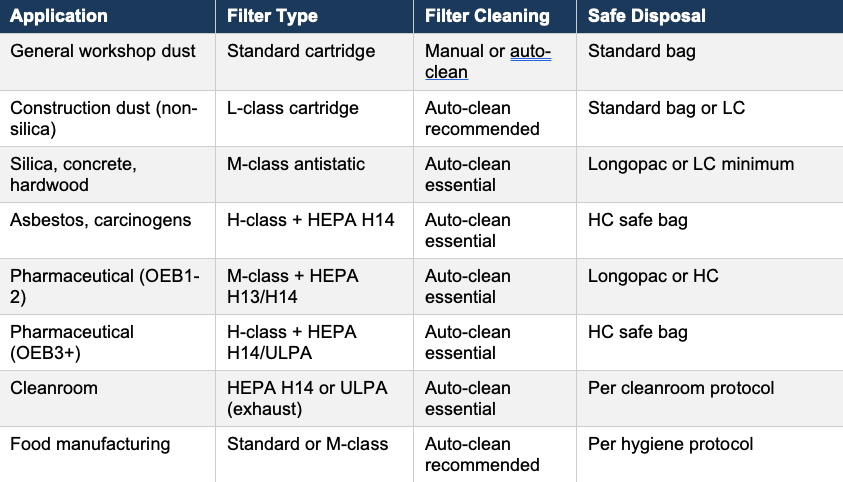
This table provides a general starting point. The specific filtration specification for your application should be determined by your risk assessment, compliance requirements, and the materials you are handling.
Filter Maintenance Best Practices
Replace filters on the schedule recommended by the manufacturer. Do not wait for visible performance degradation – by that point, the filter may have been underperforming for some time, potentially compromising compliance.
Use genuine replacement filters specified for your machine. Third-party or pattern filters may not match the performance of the original and may invalidate the machine’s dust classification certification. This is not a theoretical concern – if an HSE inspector finds a non-certified filter in a classified machine, the machine’s certification status is void.
Document every filter change as part of your equipment maintenance records. Date, filter part number, reason for replacement, and who performed the work. For M-class, H-class, and ATEX-certified equipment, this documentation is part of your compliance evidence and should be available for audit.
When replacing filters on classified machines, follow the manufacturer’s procedure for safe filter removal. H-class machines require dust-free filter replacement to prevent operator exposure. Even on M-class machines, filter changes should be performed carefully and ideally in a well-ventilated area.
✔ Free site visit — we’ll assess your facility and recommend the right solution
✔ Call us — 01677 426699 for immediate expert advice
✔ View our range — 75+ Nilfisk industrial vacuums in stock
Request Free Site Visit | View Industrial Vacuum Range | Call 01677 426699