Wet and Dry Industrial Vacuums: The Versatile Choice
If there is a default starting point in industrial vacuum selection, it is the wet and dry vacuum. These machines handle the widest range of materials and applications of any industrial vacuum category: dry dust and debris, liquid spills, mixed wet and dry waste, and everything in between. For many facilities, a well-specified wet and dry vacuum is the only type they need.
But “wet and dry” is a broad category that spans compact single-phase units costing a few hundred pounds through to heavy-duty three-phase systems exceeding £6,000. The right choice depends on what you are collecting, how much, and how often.
How Wet and Dry Vacuums Work
Wet and dry industrial vacuums use the same suction principle as any vacuum, but with design features that allow safe and effective collection of both liquids and dry materials.
The key differences from dry-only machines include sealed tank construction that contains liquids without leakage, liquid-level sensors (float valves) that automatically shut off suction when the tank reaches capacity, preventing liquid from reaching the motor. Corrosion-resistant materials (typically stainless steel) that withstand contact with water, chemicals, and industrial fluids. Drain outlets for emptying liquid waste without lifting the tank. Separate or switchable filter systems for wet and dry operation – the filter used for dry dust collection is bypassed during wet pickup to prevent damage.
Switching between wet and dry modes is typically straightforward: remove the dust filter for liquid collection, refit it for dry work. Some models automate this process, and many operators simply keep the filter fitted and rely on the float valve for occasional wet pickup alongside primarily dry use.
Single Phase vs Three Phase: Which Wet and Dry?
Wet and dry vacuums are available across the full power spectrum, and the single-phase versus three-phase decision has the same implications here as for any industrial vacuum.
Single Phase (110V / 240V)
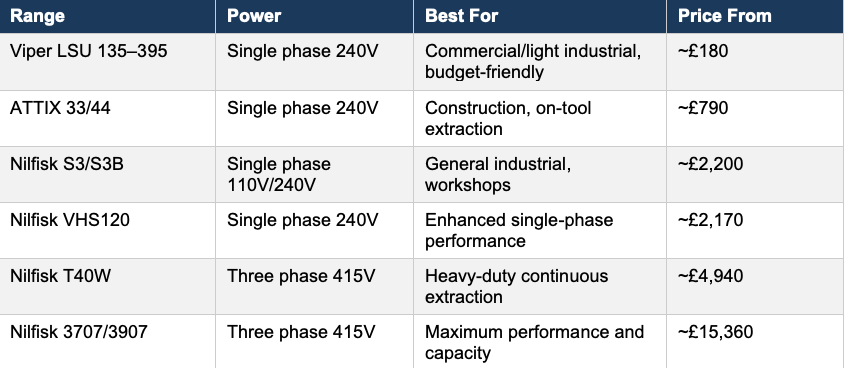
For workshops, smaller facilities, construction sites, and intermittent cleaning tasks. CFM stocks single-phase wet and dry vacuums across several ranges. The Nilfisk S3 and S3B offer genuine industrial build quality with L-class filtration and automatic filter cleaning from around £2,200. The VHS120 series provides enhanced performance for more demanding single-phase applications from around £2,170. The ATTIX range offers industrial wet and dry capability from around £790. The Viper LSU series delivers commercial-grade wet and dry capability from just £180 for lighter-duty requirements.
Three Phase (415V)
For production environments, continuous operation, and high-volume extraction. The Nilfisk T40W delivers heavy-duty wet and dry performance in a robust three-phase package from around £5,000. The VHW range (VHW320, VHW421, VHW440) provides stainless steel three-phase wet and dry capability, primarily for food and pharmaceutical environments. The 3707 and 3907 series are the heavyweights of the range, designed for the most demanding continuous extraction applications.
Single Phase vs Three Phase Industrial Vacuums →
Key Selection Factors
What Are You Collecting?
General workshop dust and occasional liquid spills suit a versatile mid-range unit. If liquids are the primary material, consider tank capacity and drain outlet design carefully – you will be emptying liquid waste frequently. For mixed materials including oils, coolants, or chemicals, check material compatibility and consider whether a specialist oil recovery vacuum might be more appropriate.
How Much Material?
Tank capacity ranges from 15 litres on compact units to over 100 litres on large three-phase machines. High-volume applications need larger tanks to avoid constant emptying. Consider how the machine is emptied, too – tilting a 100-litre tank full of liquid is not practical without a drain valve or pump.
Duty Cycle
Intermittent workshop cleaning is well-served by single-phase equipment. Continuous or near-continuous extraction alongside production processes demands three-phase motors rated for sustained operation.
Filtration Requirements
If you are collecting hazardous dust as well as general debris and liquids, the machine’s dry filtration must be classified to the appropriate L, M, or H standard. Not all wet and dry vacuums carry dust classification certification – check before purchasing.
CFM’s Wet and Dry Range at a Glance
Common Applications
Workshop and factory floor cleaning is the bread and butter: sweeping up dust, debris, metal particles, and mopping up spills with a single machine. Construction sites rely on wet and dry vacuums for dust suppression in conjunction with power tools, cleanup after cutting, drilling, and grinding, and managing water ingress. Manufacturing facilities use them for end-of-shift cleanup, maintenance around production equipment, and general housekeeping. Automotive workshops depend on wet and dry capability for brake dust, oil spills, coolant, and general workshop debris.
Maintenance Tips
Wet and dry vacuums work hardest of any industrial vacuum category because they handle the widest range of materials. A few maintenance practices keep them performing reliably.
Empty liquid waste promptly – standing liquid encourages bacterial growth and odour, particularly in warm environments. Rinse the tank after wet use, especially if collecting chemicals, coolants, or food-related liquids. Check the float valve regularly – a stuck or damaged float valve will not protect the motor from liquid ingestion. Inspect seals and gaskets for damage from chemical exposure. Replace filters on schedule and never use a wet filter for dry dust collection.
✔ Free site visit — we’ll assess your facility and recommend the right solution
✔ Call us — 01677 426699 for immediate expert advice
✔ View our range — 75+ Nilfisk industrial vacuums in stock
Request Free Site Visit | View Industrial Vacuum Range | Call 01677 426699