Industrial Vacuums for Oil and Swarf Recovery
Every engineering workshop and metalworking facility faces the same challenge: CNC machines, lathes, milling machines, and grinders produce a constant stream of cutting oil, coolant emulsion, and metal swarf that needs to be managed. Left unattended, this mixture creates slip hazards, damages equipment, and wastes expensive cutting fluids.
Standard industrial vacuums are not designed for this job. Oils and coolants damage conventional filters, metal shavings are abrasive and heavy, and without a separation system the collected fluid is contaminated waste rather than reusable resource. This is where specialist oil and swarf recovery vacuums earn their keep – and often pay for themselves through fluid recycling alone.
How Oil and Swarf Vacuums Work
Oil and swarf recovery vacuums are built around a separation principle. The machine draws in the mixture of cutting oil or coolant emulsion along with metal chips, shavings, and swarf through a standard suction hose. Inside the machine, the liquid and solid components are separated through macrofiltration – essentially a basket or screen that retains the solid metal particles while allowing the liquid to pass through into the main tank.
The recovered liquid – whether cutting oil, coolant, or emulsion – collects in the tank ready for reuse. Most machines include a discharge pump or gun that allows the operator to pump the clean fluid directly back into the CNC machine’s coolant reservoir. This can be done while the vacuum is still operating, which means the entire process – suction, separation, and return – happens in a single continuous operation.
The solid metal swarf is retained in a removable basket or container for disposal or recycling. Because the liquids have been separated, the swarf is relatively dry and can be handled, stored, and sold for scrap more easily than a wet, contaminated mixture.
Why Coolant Recovery Matters Financially
This is where the business case becomes compelling. Cutting oils and coolant emulsions are expensive consumables. A single CNC machine can use tens of litres of coolant, and a busy workshop may have dozens of machines, each requiring regular top-ups.
When coolant is discarded along with swarf – which is what happens when you use standard vacuum equipment or manual cleanup methods – you are throwing away a significant, recurring cost. Replacement coolant must be purchased. Disposal of contaminated waste must be arranged, often at additional expense. And machine downtime while coolant tanks are cleaned and refilled adds a further hidden cost.
An oil recovery vacuum eliminates most of this waste by separating the reusable fluid and returning it to the machine. Depending on your volume of metalworking, the fluid savings alone can repay the cost of the vacuum within months rather than years.
CFM’s Oil and Swarf Range
CFM stocks the full Nilfisk oil and swarf recovery range. Each model is purpose-built for the engineering industry:
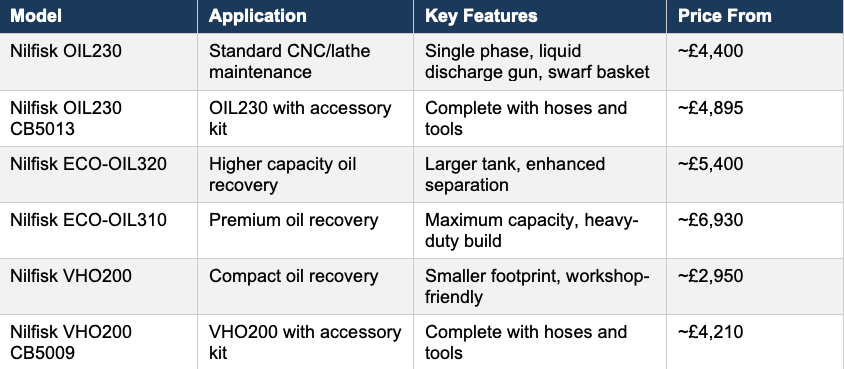
The OIL230 is the workhorse of the range, handling standard workshop oil and swarf recovery duties. The ECO-OIL310 and ECO-OIL320 step up capacity for larger operations with multiple machines to service. The VHO200 offers a more compact option for smaller workshops where floor space is at a premium.
Typical Applications
CNC Machine Maintenance
The primary application. CNC machining centres accumulate metal chips and spent coolant in the machine bed and coolant tank. Without regular extraction, chips block coolant nozzles, contaminate the cutting fluid, and reduce machining accuracy. Regular vacuuming with an oil recovery unit keeps machines running cleanly and extends coolant life.
Lathe and Milling Machine Cleanup
Manual lathes and milling machines produce continuous swarf during operation. Long, stringy swarf from turning operations and heavier chips from milling both need removal. Oil recovery vacuums handle these materials while simultaneously recovering the cutting oil for reuse.
Coolant Tank Cleaning
Over time, CNC coolant tanks develop sludge – a mixture of fine metal particles, biological growth, and degraded coolant. Oil recovery vacuums can be used to evacuate coolant tanks for deep cleaning, separating recoverable fluid from waste. This extends the useful life of the coolant charge and prevents the bacterial contamination that causes coolant to smell and degrade.
Workshop Floor Maintenance
Oil spills and swarf on workshop floors create slip hazards and make the working environment unpleasant and unsafe. Regular vacuuming prevents accumulation and reduces the risk of accidents. The wet and dry capability of oil recovery vacuums handles both the oil and the metal debris in a single pass.
Choosing the Right Oil Recovery Vacuum
The key factors in selecting an oil recovery vacuum are the number of machines you need to service and therefore the volume of fluid and swarf generated, the type of cutting fluid (neat oil vs water-based coolant emulsion), available floor space for the vacuum unit, and whether you need the machine to be mobile between work areas or positioned permanently.
For a small workshop with two or three CNC machines, the VHO200 provides a compact, effective solution. For larger facilities with multiple machining centres, the OIL230 or ECO-OIL310 offer the tank capacity and throughput to service the whole shop floor efficiently.
Maintenance and Care
Oil recovery vacuums require regular maintenance to keep the separation system working effectively. The swarf basket must be emptied regularly to prevent blockage. Filters should be inspected and cleaned on schedule. The discharge pump and associated seals need checking to ensure clean fluid return. The tank itself should be cleaned periodically to prevent sludge buildup.
CFM’s service team are factory-trained on the full Nilfisk oil recovery range and can set up a planned maintenance schedule tailored to your usage pattern.
✔ Free site visit — we’ll assess your facility and recommend the right solution
✔ Call us — 01677 426699 for immediate expert advice
✔ View our range — 75+ Nilfisk industrial vacuums in stock
Request Free Site Visit | View Industrial Vacuum Range | Call 01677 426699