Industrial Vacuums for Packaging and Trim Extraction
Packaging and production lines generate continuous waste: cardboard trim, plastic film offcuts, shrink wrap, label backing, paper dust, and a dozen other materials that accumulate quickly and disrupt operations if not managed effectively.
Standard industrial vacuums are designed for general cleanup – they handle dust, debris, and occasional spills. Packaging and trim extraction is a fundamentally different task: continuous, high-volume extraction running alongside a production process, often for entire shifts at a time. It demands equipment specifically designed for sustained operation and high-throughput material handling.
This is a specialist category where very little guidance exists in the UK market. Most businesses either cobble together makeshift extraction solutions or are simply unaware that purpose-built equipment is available. This guide explains what packaging and trim vacuums do, when you need one, and what CFM can supply.
What Makes Packaging Extraction Different
Three characteristics set packaging and trim extraction apart from general industrial vacuuming.
First, continuous operation. The vacuum runs alongside the production or packaging line, extracting waste as it is generated. This is not intermittent cleaning – the machine operates for the entire duration of the production run, which may be an eight-hour shift, a twelve-hour shift, or around the clock.
Second, high volume. Packaging lines can generate substantial volumes of trim waste. Cardboard edge trimmings, plastic film offcuts, and label waste add up quickly. The vacuum must have sufficient tank capacity and airflow to handle this volume without requiring constant emptying or losing suction under load.
Third, material type. Packaging materials are often lightweight, bulky, and awkward to handle. Plastic film can wrap around filters. Cardboard trim can bridge across tank openings. Standard vacuum designs are not optimised for these materials – purpose-built machines handle them reliably.
CFM’s Packaging and Trim Range
CFM stocks the Nilfisk R305 and R104 ranges, both designed specifically for production line integration and continuous trim extraction.
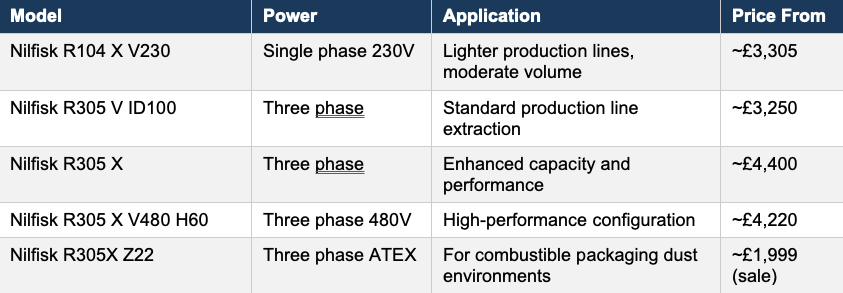
The R305 is the core machine in this range, available in multiple configurations to match different production line requirements. The R104 offers a more compact alternative for lower-volume applications. Both are engineered for the sustained, continuous duty that packaging extraction demands.
Typical Applications
Cardboard and Corrugated Packaging
Box-making, die-cutting, and packaging assembly lines generate continuous edge trimmings and offcuts. Extraction at the point of generation keeps the line clean, prevents trim from jamming machinery, and collects waste for recycling or disposal in an organised way.
Plastic Film and Shrink Wrap
Film wrapping, shrink wrapping, and bag-making operations produce continuous film trim that is awkward to handle manually. Purpose-built extraction removes trim automatically, preventing accumulation on the line and reducing the risk of film wrapping around moving parts.
Label and Paper Waste
Labelling lines generate backing paper, misprinted labels, and adhesive waste. Extraction keeps the labelling area clean and prevents waste from contaminating products or machinery.
Multi-Material Production
Modern packaging lines often combine cardboard, plastic, paper, and foil in the same process. Extraction vacuums need to handle this mix reliably without blockage or performance loss.
Integration with Production Lines
The key to effective packaging extraction is integration. The vacuum is not a standalone cleaning tool – it is part of the production process. Extraction points are positioned at trim generation points along the line, with ducting running to the central vacuum unit. The vacuum runs whenever the line runs, and stops when production stops.
Getting this integration right requires understanding the specific production line layout, material types, volume generated, and extraction point locations. CFM’s team has extensive experience in specifying and positioning extraction equipment for production environments and can advise on the right setup for your operation.
Combustible Dust Considerations
Some packaging materials generate dust that can be combustible in sufficient concentration. Paper dust, cardboard dust, and certain plastic dusts can all create explosive atmosphere risks under the right conditions.
If your DSEAR risk assessment identifies a combustible dust hazard in your packaging area, you will need ATEX-certified extraction equipment. The Nilfisk R305X Z22 provides packaging extraction capability with Zone 22 ATEX certification, allowing operation in areas where combustible dust may be present under abnormal conditions.
✔ Free site visit — we’ll assess your facility and recommend the right solution
✔ Call us — 01677 426699 for immediate expert advice
✔ View our range — 75+ Nilfisk industrial vacuums in stock
Request Free Site Visit | View Industrial Vacuum Range | Call 01677 426699