
ACD Vacuum Cleaners: The Complete Guide to Collecting Combustible Dust Outside ATEX Zones
An ACD vacuum cleaner is an industrial vacuum designed and tested to collect combustible dust safely in areas that are not classified as ATEX hazardous zones. ACD stands for Appliance for Combustible Dust. The category was introduced in the 2021 edition of IEC 60335-2-69, the international safety standard for commercial and industrial vacuum cleaners, and it fills a gap that has existed on UK sites for years: the flour, sugar, wood or powder that ends up on the floor of a room nobody has zoned.
This guide explains what ACD means, what the standard requires, how it relates to ATEX and to L, M and H dust classes, where ACD machines are used, and what to check before you buy or hire one.
What is an ACD vacuum cleaner?
An ACD vacuum is a machine whose dust-laden section contains no internal ignition source, so it can pick up combustible dust without the risk of igniting that dust inside the machine. The requirements sit in Annex AA of IEC 60335-2-69:2021 (sixth edition), the same annex that defines the familiar L, M and H dust classes.
The reason this matters is simple. A vacuum cleaner takes a settled layer of dust, which is relatively hard to ignite, and turns it into a well-mixed cloud travelling at speed into a confined container. HSE guidance on dust explosions in the food industry makes exactly this point: whenever a vacuum is being used, there will almost always be a dust cloud inside it at some stage. If a filter bag splits or comes loose, that cloud can reach explosible concentrations inside the machine.
So even when the room is ordinary, the inside of the vacuum is not. ACD is the standard that deals with that internal risk.
Why was ACD introduced when ATEX already exists?
ACD was introduced because ATEX only applies where an area has been classified as hazardous, and a great many sites handle combustible dust in areas that are, correctly, not classified.
Under the Dangerous Substances and Explosive Atmospheres Regulations 2002 (DSEAR), employers assess where explosive atmospheres could occur and zone those areas. A packing hall, a bakery production floor or a pharmaceutical tablet room may be judged non-hazardous because the dust is well contained and housekeeping is good. No zone means no requirement for ATEX-certified equipment.
Spillages still happen, though. A pallet truck punctures a sack of flour. A filter on a production line fails. A bag of sugar splits during decanting. Somebody has to clean it up, and until 2021 the choice was awkward:
buy an ATEX machine certified for a classified area the room does not have, which is permitted but often hard to justify on cost; or
use a general industrial or commercial vacuum and rely on its filters to keep the dust away from the motor.
HSE recognised this dilemma long before ACD existed. Its guidance on vacuum cleaners for flammable dust is written specifically for employers who cannot justify ATEX-rated cleaning equipment, and it sets out how such machines should be designed, used, located and maintained. ACD takes those same principles and turns them into a defined, testable standard.
Is ACD a lower grade of ATEX?
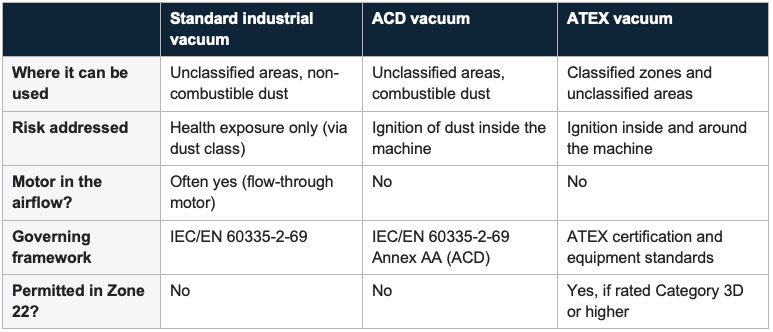
No. ACD is often described as sitting just below ATEX, but it is more accurate to say it sits alongside it and answers a different question.
ATEX equipment is certified for use inside a classified zone. It protects against the explosive atmosphere around the machine as well as the dust inside it.
ACD equipment is designed for unclassified areas. It protects against the dust cloud created inside the machine, but it is not certified for an explosive atmosphere around it.
The practical rule is straightforward. An ACD vacuum must never be used in Zone 20, 21 or 22. An ATEX vacuum can be used in an unclassified area, although it will usually be more machine than the job requires.
What does the ACD standard actually require?
The ACD requirements focus on removing every realistic ignition source from the part of the machine that handles dust. Guidance published by EUnited Cleaning, the European association whose members include Nilfisk, Numatic, Kärcher, Truvox and Tennant, summarises them as follows:
Surface temperature limit. Any surface in contact with combustible dust must stay at or below 135°C (temperature class T4).
No flow-through motors. The motor must not be cooled by the dusty airflow, and the suction fan must sit on the clean air side of the filters.
Certified filtration. The machine must meet dust class L, M or H.
Filter durability. The main filter must pass a durability test, and testing must show it is not damaged when the machine picks up sharp objects.
Monitoring. An indicator for filter cleaning and control of air velocity.
Spark-resistant materials. Restrictions on the alloys used, to avoid mechanically generated sparks.
Ingress protection. IP54 where conductive dust is collected. IPX4 is sufficient where only small, infrequent amounts of conductive dust are picked up.
Easy cleaning. The machine must be designed so it can be cleaned out properly.
Liquid reservoirs. Machines that collect dust into a liquid bath carry extra requirements, including venting to stop hydrogen reaching electrical compartments and the correct liquid for the dust being collected.
In practice, ACD machines also use antistatic or conductive filters, earthed containers and components, and antistatic hoses and tools, so that static charge is dissipated rather than building up.
Is third-party certification required?
Not always. The standard can be met through the manufacturer’s own testing and Declaration of Conformity. Some manufacturers go further and have their ACD machines independently certified. Both routes are legitimate, but if your insurer or auditor expects independent evidence, ask for it before you buy.
How is ACD different from L, M and H dust classes?
L, M and H dust classes protect people from breathing harmful dust. ACD protects the site from the dust igniting. They answer two different legal duties, and a machine may need to satisfy both.
Dust class (L, M, H) relates to the Control of Substances Hazardous to Health Regulations (COSHH) and controls how much dust escapes the machine.
ACD relates to DSEAR and controls whether the machine could ignite what it collects.
Every ACD machine also carries a dust class, so you need to choose the right combination. Flour is a good example: it is combustible, and the EUnited Cleaning guidance suggests H class as the minimum for flour dust because of its health effects. Our L, M and H class guide explains dust classes in full.
Where are ACD vacuum cleaners used?
ACD vacuums are used wherever combustible dust is handled in an area that has not been classified as a hazardous zone. Typical applications include:
Food production and bakeries: flour, sugar, starch, cocoa, milk powder and spice spillages on production floors outside milling and silo areas.
Pharmaceutical manufacturing: lactose, cellulose and other powders around tablet presses and packaging lines.
Woodworking: fine wood dust at machine level in workshops where the central extraction plant is zoned but the shop floor is not.
Plastics, rubber and powder coating: fine polymer and coating powders in general production areas.
Packaging and warehousing: occasional spillages of combustible products such as flour, sugar or animal feed.
The same substance can call for different equipment on the same site. Flour on a bakery floor may be an ACD job, while flour inside a milling area classified as Zone 22 requires an ATEX machine. The room and the process decide, not the substance on its own.
What about metal dusts?
Aluminium, magnesium, titanium and other reactive or conductive metal dusts need particular care. Conductive dust pushes the requirement to IP54, and reactive metals are often better collected into a liquid bath that neutralises them as they enter the machine. Always get specialist advice before vacuuming metal dust, whatever the area classification.
What should you check before buying or hiring an ACD vacuum?
Work through these questions in order. If any answer is unclear, resolve it before choosing a machine.
Is the area zoned? Check your DSEAR assessment. If the area is Zone 20, 21 or 22, you need ATEX, not ACD.
Is the dust combustible? Most organic powders and many metal and plastic dusts are. If in doubt, treat the dust as combustible until testing shows otherwise.
Is the dust conductive or reactive? If so, you need IP54 as a minimum and should consider a liquid-bath machine.
Which dust class does COSHH require? Match L, M or H to the health hazard as well as the ignition hazard.
What does the paperwork say? Look for a Declaration of Conformity that references IEC/EN 60335-2-69 and the ACD requirements, and ask whether the machine has independent certification.
Are the hose and tools right? Use antistatic or conductive hoses and earthed tools. HSE recommends stainless steel tools rather than aluminium, because aluminium striking rusty steel can produce thermite sparks.
Is there a maintenance routine? HSE advises changing or cleaning filters at fixed intervals rather than leaving it to the operator, and making sure the machine is never run without its filters correctly fitted.
Are operators trained? They should know not to pick up wet, hot or smouldering material, and how to refit filters so they seal properly.
What are the most common misunderstandings about ACD?
"ACD is just cheaper ATEX"
It is not. ACD has a different scope and is never permitted inside a classified zone.
"An antistatic vacuum is the same as ACD"
Antistatic hoses and earthed components are useful, but they are only part of the requirement. A machine with an antistatic hose and a flow-through motor is not an ACD machine.
"If the room is not zoned, any industrial vacuum will do"
The room classification says nothing about the dust cloud inside the vacuum. If the dust is combustible, the machine needs to be designed for it.
"An H class vacuum is safe for combustible dust"
H class is about health protection. An H class machine with its motor in the airflow is still an ignition risk with combustible dust.
Getting the decision right
The right machine depends on three things: how the area is classified, what the dust is, and how the machine will actually be used day to day. Getting any one of those wrong can leave you with equipment that is either unsafe or needlessly expensive.
CFM North East has been advising on industrial cleaning equipment for more than 25 years and is an approved Nilfisk supplier. We offer a free site visit, where we look at your DSEAR assessment, the dusts you handle and how cleaning happens in practice, then recommend the right option, whether that is an ACD machine, an ATEX machine or something simpler. We are experts in both ACD and ATEX categories and both are widely stocked. Machines are available to buy, hire or lease, and we can demonstrate them on your site before you commit.
Frequently asked questions
What does ACD stand for?
ACD stands for Appliance for Combustible Dust. It is a category of vacuum cleaner defined in IEC 60335-2-69 for collecting combustible dust in areas that are not classified as hazardous zones.
Can I use an ACD vacuum in Zone 22?
No. Zone 22 requires ATEX-certified equipment of at least Category 3D. ACD machines are only for unclassified areas.
Can I use an ATEX vacuum where an ACD vacuum would do?
Yes. An ATEX vacuum is permitted in an unclassified area. It is simply more specification, and usually more cost, than the job needs.
Do ACD vacuums have a dust class?
Yes. Every ACD machine must also meet dust class L, M or H, so you need to choose the class that matches the health hazard of the dust.
When was ACD introduced?
ACD was introduced in 2021 in the sixth edition of IEC 60335-2-69, the international safety standard for commercial vacuum cleaners and dust extractors.
