Industrial Vacuum vs Commercial Vacuum: What’s the Difference?
It is one of the most common questions we hear at CFM North East: “Do I actually need an industrial vacuum, or will a commercial one do the job?”
It is a fair question. On the surface, both types of machine do the same thing as they create suction to collect dust and debris. The price difference, however, can be significant. A decent commercial vacuum might cost a few hundred pounds. A mid-range industrial vacuum typically runs into several thousand. So what are you actually paying for, and does it matter?
The short answer: yes, it matters. The difference between industrial vacuum cleaners and commercial vacuum cleaners is not a matter of branding or markup. It is a fundamental difference in what the machine is designed to do, how long it is designed to do it for, and what it is certified to handle safely.
This guide breaks down those differences so you can make an informed decision for your workplace.
The Fundamental Difference: Built for Different Jobs
A commercial vacuum cleaner is designed for daily cleaning in offices, retail spaces, hotels, schools, and similar environments. It handles household-type dust, light debris, and general floor cleaning across carpet, tile, and hard surfaces. It is built to run for a few hours per day, be relatively lightweight and manoeuvrable, and is operated by cleaning staff who need something intuitive and easy to handle.
An industrial vacuum cleaner is designed for manufacturing, construction, warehousing, engineering, and other heavy-duty environments. It handles fine metalworking dust, concrete debris, wood shavings, oil and coolant, hazardous materials, combustible dust, and large-volume waste. It is built to run continuously across full shifts or 24 hours a day on production lines in conditions that would destroy a commercial machine within weeks.
The distinction is not about one being “better” than the other. A commercial vacuum is excellent at what it is designed for. But using one in an environment that demands an industrial machine creates three problems: it will underperform, it will break down quickly, and it may put you on the wrong side of health and safety regulations.
Key Differences: Side by Side
The table tells the story clearly, but a few of these differences deserve a closer look.
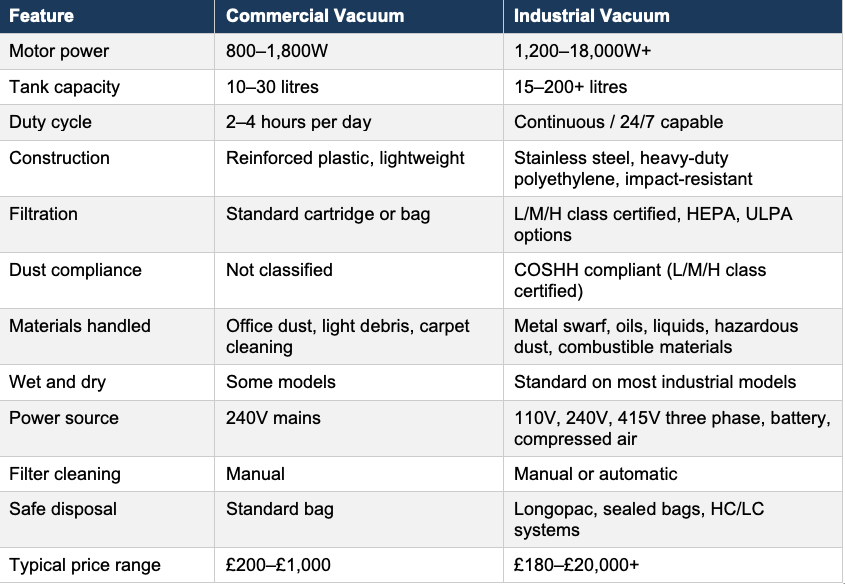
Power and Suction: Why It Matters More Than You Think
A commercial vacuum with 1,200W of motor power generates adequate suction for office carpets and hard floors. That same suction level is completely inadequate for extracting metal shavings from around a CNC machine, clearing concrete dust from a construction site, or recovering cutting oil from a workshop floor.
Industrial vacuums start at similar power levels for lighter applications but scale up dramatically. Three-phase 415V machines can deliver suction performance that would be physically impossible on a standard mains circuit. The Nilfisk 3707 and Nilfisk 3907 series, for example, use motors producing airflow rates that dwarf anything in the commercial category.
But raw power is only half the equation. Sustained suction over time matters just as much. A commercial vacuum’s suction drops as its filter clogs — and without automatic filter cleaning, it drops quickly under heavy dust loads. Industrial vacuums with automatic filter cleaning systems pulse reverse airflow through the filter every 15 seconds, maintaining consistent suction throughout the working day.
Industrial Vacuum Filtration Guide — HEPA, Cartridge and Safe Disposal Systems →
Duty Cycle: The Difference Between Hours and Shifts
Duty cycle is perhaps the most important and most overlooked distinction between commercial and industrial equipment.
A commercial vacuum is designed for intermittent use: an hour here, two hours there, with rest periods in between. Run it continuously for a full eight-hour shift and you will burn out the motor, overheat the electrics, and void the warranty. The components simply are not engineered for sustained operation.
Industrial vacuums are built for exactly that kind of sustained workload. Motors are designed for continuous duty ratings. Bearings, seals, and electrical components are specified for thousands of hours of operation. Cooling systems prevent overheating during extended runs. Three-phase industrial vacuums in production environments routinely operate across two or three shifts per day, five to seven days per week.
If your application requires more than a couple of hours of vacuuming per day, or if the machine needs to run continuously alongside a production process, you need industrial-grade equipment. There is no workaround for this — a commercial vacuum used beyond its duty cycle will fail, and it will fail sooner than you expect.
Filtration and Compliance: Where the Law Gets Involved
This is where the distinction moves from practical to legal.
Commercial vacuums use standard filters that are perfectly adequate for household-type dust. But in industrial environments, dust is not just a nuisance — it is a regulated health hazard. The Control of Substances Hazardous to Health (COSHH) Regulations place legal obligations on employers to control worker exposure to harmful dust.
Industrial vacuums are classified into three dust classes based on their filtration capability:

These classifications apply to the entire machine — not just the filter. A commercial vacuum with a HEPA filter bolted in is not M-class. The whole system — motor, seals, filter, containment, disposal — must be tested and certified together by an independent third party.
If your workplace generates any of the materials listed above, using a non-classified vacuum is not just ineffective — it is a regulatory breach. The HSE can issue improvement notices, prohibition notices, and fines for COSHH non-compliance. In serious cases, directors and managers can face personal prosecution.
Beyond L/M/H classification, environments with combustible dust may require ATEX-certified equipment or ACD (Appliance for Combustible Dust) designated machines — further levels of certification entirely. Our ATEX Industrial Vacuum Superguide covers this in full detail.
Dust Classification Guide — Understanding L, M and H Class →
ATEX Industrial Vacuum Superguide →
Build Quality and Total Cost of Ownership
The upfront price of a commercial vacuum is lower — that is obvious. What is less obvious is the total cost of ownership when you use commercial equipment in an industrial setting.
A commercial vacuum used in a factory or workshop will typically need replacing every 6 to 12 months. Motors burn out, plastic housings crack, seals fail, and the cost of repeated replacement quickly exceeds the one-off investment in a properly specified industrial machine.
Industrial vacuums are built with stainless steel tanks, reinforced chassis, industrial-grade motors with replaceable brushes, and serviceable components designed to be maintained rather than discarded. A well-maintained Nilfisk industrial vacuum will last for years, with routine servicing extending its productive life further still.
Factor in the cost of downtime when a commercial machine fails mid-shift, the labour cost of more frequent emptying with smaller tanks, and the compliance risk of using non-certified equipment, and the true cost picture becomes clear. The industrial vacuum is almost always the more economical choice for any environment that demands more than light, intermittent cleaning.
What Happens When You Get It Wrong: A Real-World Scenario
Consider a joinery workshop generating hardwood dust throughout the day. The manager buys a £400 commercial wet and dry vacuum rather than spending £2,500 on a classified industrial unit. Here is what typically follows.
Within the first month, suction drops noticeably because the filter clogs quickly under heavy fine dust loading. There is no automatic filter cleaning, so the operator stops work twice per shift to clean the filter manually — each time exposing themselves to a burst of concentrated hardwood dust in their breathing zone.
By month three, the motor is overheating from running beyond its designed duty cycle. The plastic housing has cracked where it has been knocked by workshop trolleys. The seals around the tank lid are no longer airtight, allowing fine dust to escape during operation. The machine is replaced with an identical model.
By month six, the HSE visits. The inspector identifies that hardwood dust requires M-class extraction at minimum. The commercial vacuum has no dust classification. An improvement notice is issued, requiring the business to install correctly classified equipment within 21 days. The cost of two commercial vacuums, the improvement notice, and the compliance upgrade now significantly exceeds the cost of the industrial vacuum that should have been purchased in the first place.
This is not a hypothetical. Variations of this scenario play out in workshops and small manufacturing units across the UK every year.
When a Commercial Vacuum Is the Right Choice
It would be dishonest to suggest that every workplace needs an industrial vacuum. Commercial vacuums are the correct choice for plenty of applications:
Office environments with standard carpet and hard floor cleaning. Retail spaces with light foot traffic and general dust. Hotels and hospitality with daily room cleaning and common area maintenance. Schools and education facilities for classroom and corridor cleaning. Small workshops with light, infrequent dust generation where no hazardous materials are present.
If the dust is household-type, the cleaning is intermittent, no compliance classification is required, and the machine does not need to run for extended periods, a commercial vacuum is perfectly fit for purpose. CFM stocks the Viper by for exactly these applications — professional-grade commercial wet and dry vacuums starting from around £180.
When You Need an Industrial Vacuum
You need industrial-grade equipment when any of the following apply:
Your application generates metal dust, swarf, oil, or cutting fluids. You handle any material classified as hazardous under COSHH (hardwood, silica, concrete, pharmaceutical actives). You need continuous or extended operation — more than a few hours per day. Your environment includes combustible dust requiring ATEX certification or ACD (Appliance for Combustible Dust) designation. You need wet and dry capability for industrial-scale liquid recovery. Your facility requires three-phase power for the suction performance needed. You need certified filtration (L, M, or H class) to meet regulatory obligations.
If even one of these applies, a commercial vacuum is the wrong tool for the job. The question then becomes which industrial vacuum is right — and that depends on your specific application, materials, environment, and compliance requirements.
Industrial Vacuum Buying Guide — Selecting the Right Equipment →
View CFM’s full industrial vacuum range →
The Grey Area: What About “Heavy-Duty” Commercial Vacuums?
Some manufacturers market machines as “heavy-duty” or “professional” vacuum cleaners, positioned between commercial and industrial. These machines are typically more robust than standard commercial units and may offer higher suction and larger tanks, but they are rarely certified to any dust classification standard.
For light industrial use — a clean workshop with minimal dust, occasional cleanup rather than continuous extraction, no hazardous materials — these machines can bridge the gap. But for any application involving compliance requirements, sustained operation, or hazardous materials, they are not a substitute for properly certified industrial equipment.
If you are unsure where your needs sit, that is exactly the kind of question our team helps businesses answer every day. A free site visit from CFM will assess your environment, identify your requirements, and recommend the right level of equipment — without overselling.
✔ Free site visit — we’ll assess your facility and recommend the right solution
✔ Call us — 01677 426699 for immediate expert advice
✔ View our range — 75+ Nilfisk industrial vacuums in stock
Request Free Site Visit | View Industrial Vacuum Range | Call 01677 426699